
Embedded AI Market Accelerates with Advancements in Semiconductor Design and Edge-Based AI Deployment, Valued at USD 42.3 billion by 2033
Significant focus on ultra-low latency in autonomous systems is forcing a massive migration of neural networks directly onto microcontrollers at the edge. Embedded AI market accelerates as real-time edge inference enables faster decision-making in autonomous machines and intelligent connected devices.
Mayfair, United Kingdom, March 18, 2026 (GLOBE NEWSWIRE) -- The embedded AI market is witnessing rapid expansion as organizations increasingly deploy AI directly within hardware systems to enable real-time data processing and autonomous decision-making. The embedded AI market is estimated to be valued at around USD13.8 billion in 2026 and is projected to create a revenue of USD 42.3 billion by 2033, witnessing a 17.3% CAGR. Embedded AI integrates machine learning models into edge devices such as sensors, processors, cameras, and controllers, allowing systems to analyze data locally without relying on cloud infrastructure.
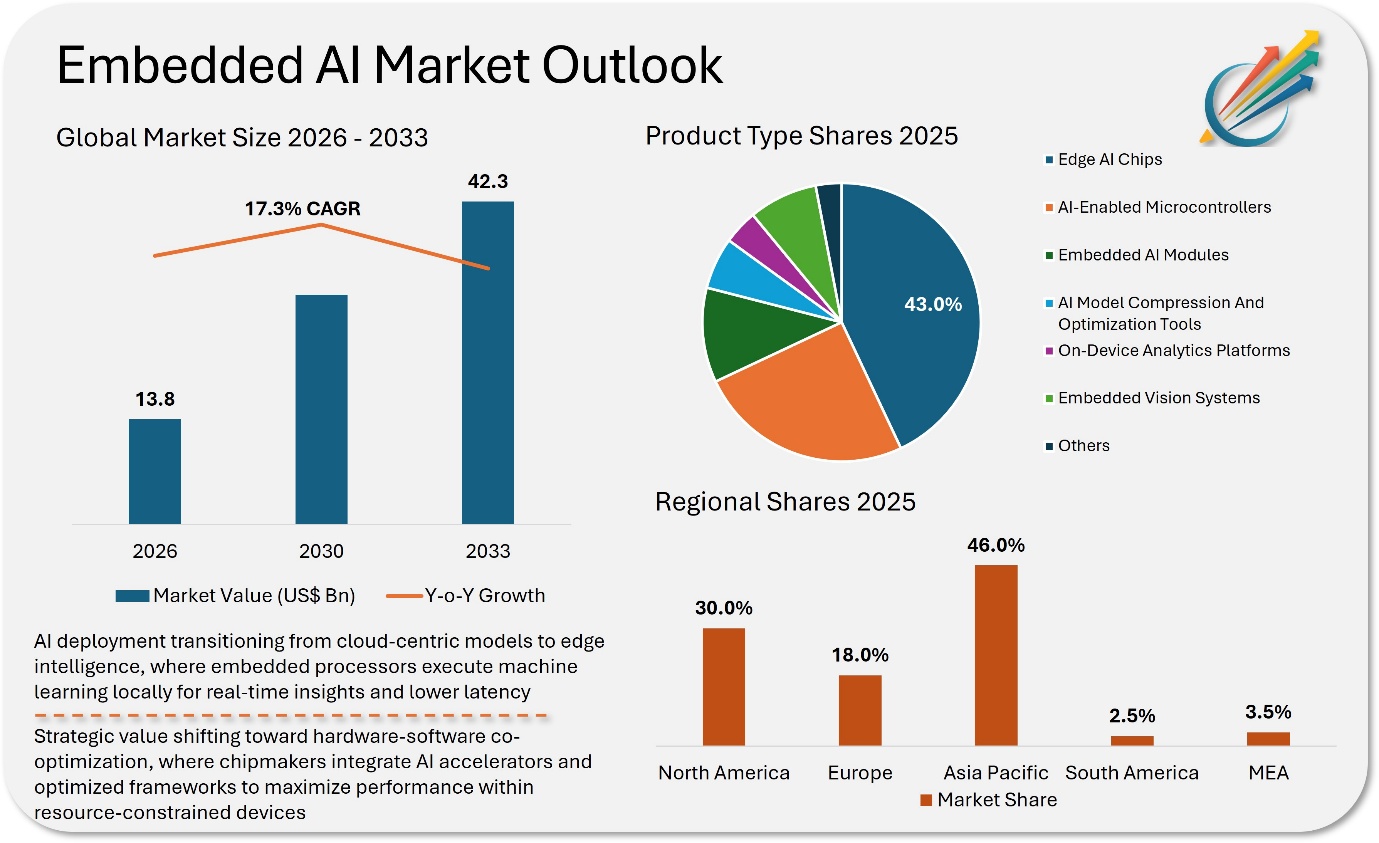
Advancements in AI chipsets, neural processing units (NPUs), optimized software frameworks and others are enabling efficient on-device inference with reduced latency and improved data privacy. Embedding intelligence directly into edge devices ensures real-time responsiveness and compliance, anchoring these microchips deeply into the next generation of industrial, medical, and consumer infrastructures. Governments and enterprises are prioritizing edge computing architectures to enhance security and operational efficiency. As smart devices, autonomous systems and IoT networks expand, edge AI is emerging as a foundational technology enabling next-generation digital infrastructure.
Access the Executive Summary & Sample Data: https://marketmindsadvisory.com/request-sample/?report_id=40357
Key Takeaways from Embedded AI Market
- NPUs and AI accelerators are the prominent types in the embedded AI market
- AI-enabled processors and edge AI chipsets remain the largest revenue-generating product segment.
- Computer vision-based embedded AI applications expected to be the fastest-growing segment
- China, Taiwan and South Korea are emerging as key investment hotspots in embedded AI market for localized AI chip fabrication.
- Increasing competition is owing to AI semiconductor innovation and strategic partnerships.
- Demand for ultra-low-power, offline voice recognition is creating white spaces in smart home tech for embedded AI market players.
- Industrial automation and autonomous vehicles becoming major adoption segment of embedded AI systems.
Market Dynamics Shaping the Embedded AI Market
Demand for Real-Time Edge Intelligence in Connected Devices is Bolstering Embedded AI Market
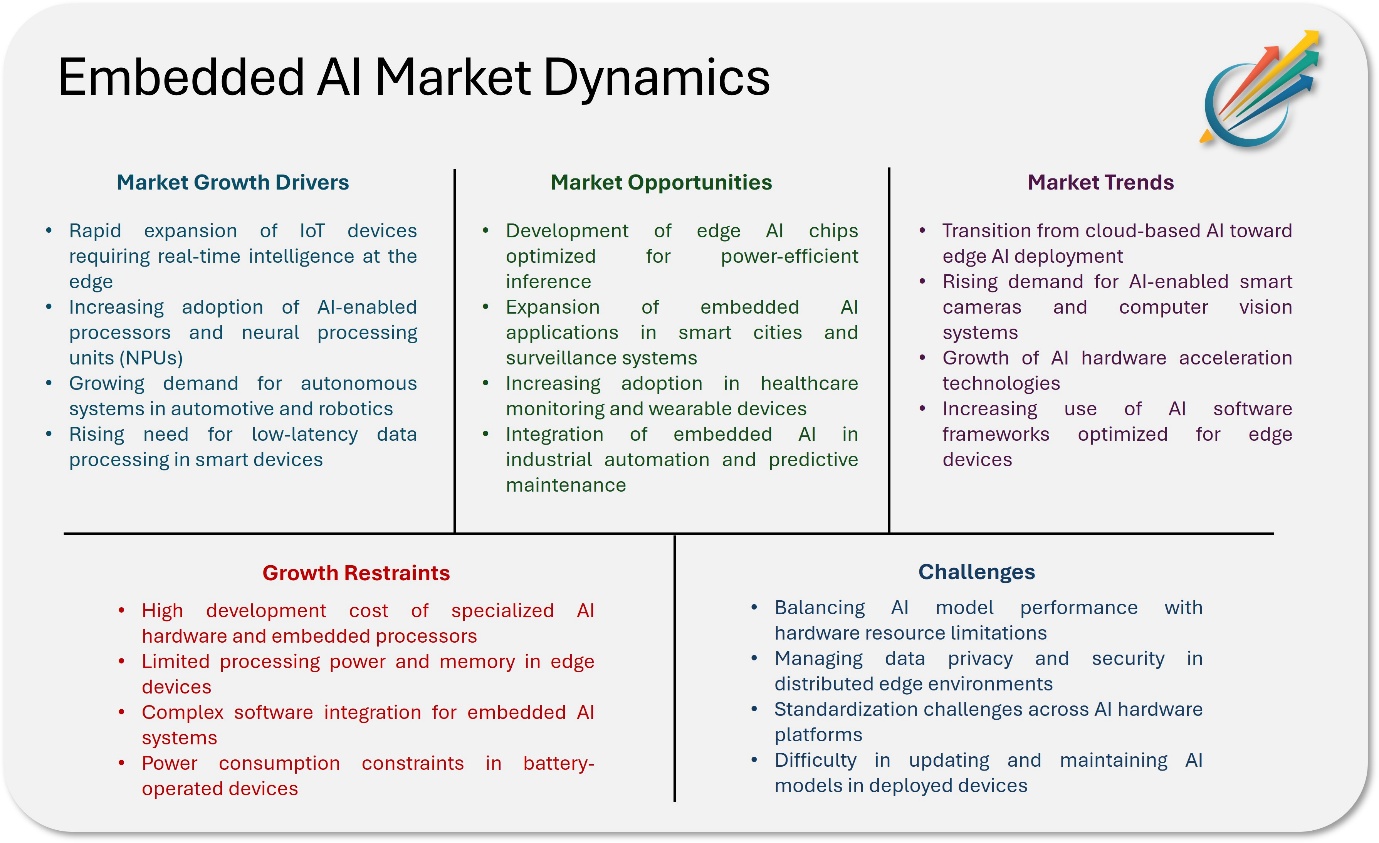
The proliferation of connected devices and IoT systems is driving demand for embedded AI solutions capable of processing data locally. Conventional cloud-based models often face latency challenges, bandwidth constraints as well as data privacy concerns. Embedded AI addresses these issues by enabling devices to analyze and interpret data directly. This capability is important in time-sensitive environments such as, autonomous vehicles, robotics, smart surveillance and industrial automation systems. Real-time decision-making significantly improves operational efficiency and system responsiveness, since industries rely on intelligent edge devices, embedded AI market is becoming a critical technology component within next-generation digital ecosystem.
Growth of AI Semiconductor Innovation and Edge Hardware Ecosystems creating Ample Opportunities for Embedded AI Market
Rapid advancements in AI hardware are creating new white spaces across the embedded AI market. Semiconductor manufacturers are developing specialized AI accelerators, neural processing units and low-power AI chipsets designed specifically for edge devices. These processors allow complex machine learning models to run efficiently on compact hardware platforms. Simultaneously, improvements in software frameworks and model optimization techniques are making AI deployment easier for developers. Emerging applications in smart cities, robotics, healthcare monitoring devices, and autonomous industrial systems are expanding the addressable market.
Request Region-Specific Data Analysis: https://marketmindsadvisory.com/request-customization/?report_id=40357
Hardware Complexity and Power Efficiency Challenges Restricting Embedded AI Market Growth
Embedded AI deployment presents technical challenges related to hardware constraints and energy efficiency owing to supply constraints and rising prices. Many edge devices operate with limited processing power, memory and battery capacity, making it difficult to run complex models efficiently. Designing AI algorithms that balance performance with power consumption remains a significant challenge for developers. Additionally, integrating AI capabilities into embedded systems requires specialized expertise in hardware architecture, firmware development, as well as machine learning optimization. These complexities increase development costs and slow implementation across certain industries.
Embedded AI Market Segmentation
By Product Type
- Edge AI Chips
- Neural Processing Units (NPU)
- Graphics Processing Units (GPU)
- Digital Signal Processors (DSP)
- Application Specific Integrated Circuits (ASIC)
- AI-Enabled Microcontrollers
- Embedded AI Modules
- AI Model Compression & Optimization Tools
- On-Device Analytics Platforms
- Embedded Vision Systems
- Others
Edge AI chips accounts for majority of the sales in embedded AI market, driven by the increasing demand for specialized processors capable of running machine learning algorithms locally. AI accelerators and microcontrollers with integrated AI capabilities are widely deployed across smart cameras, robotics systems and autonomous vehicles. Software AG platforms also play a critical role in enabling model development, optimization, and deployment across edge devices.
By Data Type
- Image Data
- Video Data
- Sensor & Time-Series Data
- Audio & Speech Data
- Text and Natural Language Data
- Telemetry & Event Data
- Multimodal Data
Image and video data is prominent data type in embedded AI landscape due to widespread adoption of computer vision technologies. Applications such as, smart surveillance systems, autonomous vehicles, facial recognition and industrial inspection rely heavily on visual data processing at the edge. Sensor data is also a major segment in industrial IoT, predictive maintenance and environmental monitoring. Audio data processing is gaining traction in voice assistants, smart home devices as well as speech recognition systems. Text and natural language data is a smaller but growing segment as embedded devices begin to incorporate localized language processing capabilities and is expected to create ample opportunities in embedded AI market in the coming years.
By Application
- Visual Inspection
- Object Detection & Tracking
- Predictive Maintenance
- Autonomous Navigation
- Biometric Authentication & Security
- Robotics Control
- AR & MR
- Energy Management System
- Quality Control & Process Automation
- Inventory Management & Retail Analytics
- Health Monitoring
Computer vision is a key application segment within the embedded AI market due to its extensive deployment across security systems, automotive safety technologies and industrial automation platforms. Vision embedded systems allow machines to detect objects, monitor environments and interpret visual information in real time. Robotics and automation-based applications are rapidly expanding as end users are adopting intelligent machines capable of adaptive decision-making. Predictive maintenance solutions using embedded AI analyze equipment sensor data to identify operational anomalies before failures occur.
By End Use
- Automotive & Transportation
- Manufacturing Industry
- Consumer Electronics
- Healthcare
- Retail & E-Commerce
- Aerospace & Defense
- Smart Cities & Infrastructure
- Agriculture
- Logistics & Supply Chain
- Energy & Utilities
- Robotics & Automation
- Others
Consumer electronics accounts for a key share in the embedded AI market as manufacturers integrate AI capabilities into smartphones, cameras, wearables and smart home devices. Automotive applications are growing rapidly as autonomous driving technologies, advanced driver-assistance systems and vehicle intelligence platforms rely heavily on embedded AI processing. Industrial manufacturing is another major sector adopting embedded AI to enable predictive maintenance, robotics automation, and real-time quality inspection. Healthcare applications are expanding with AI-powered medical devices and monitoring systems. Smart city infrastructure including intelligent surveillance and traffic management also considered as emerging adoption area.
By Region
- North America
- Europe
- Asia Pacific
- South America
- MEA
North America is a key embedded AI market due to strong innovation ecosystems and the presence of major AI semiconductor developers in the United States. North America benefits from significant investments in autonomous vehicles, robotics and smart infrastructure. Asia-Pacific, particularly China, Japan, and South Korea, are the prominent market in both the terms of manufacturing and deploying and is further expected to experience the fastest growth as electronics manufacturing, AI chip production, warehouse and logistics sector presence, smart device adoption accelerates across the region. Europe embedded AI market is also witnessing steady expansion driven by automotive innovation and industrial automation initiatives in Germany and France.
Secure Full Access to Decision-Grade Data: https://marketmindsadvisory.com/buy-now/?report_id=40357
Competitive Landscape – Embedded AI Market
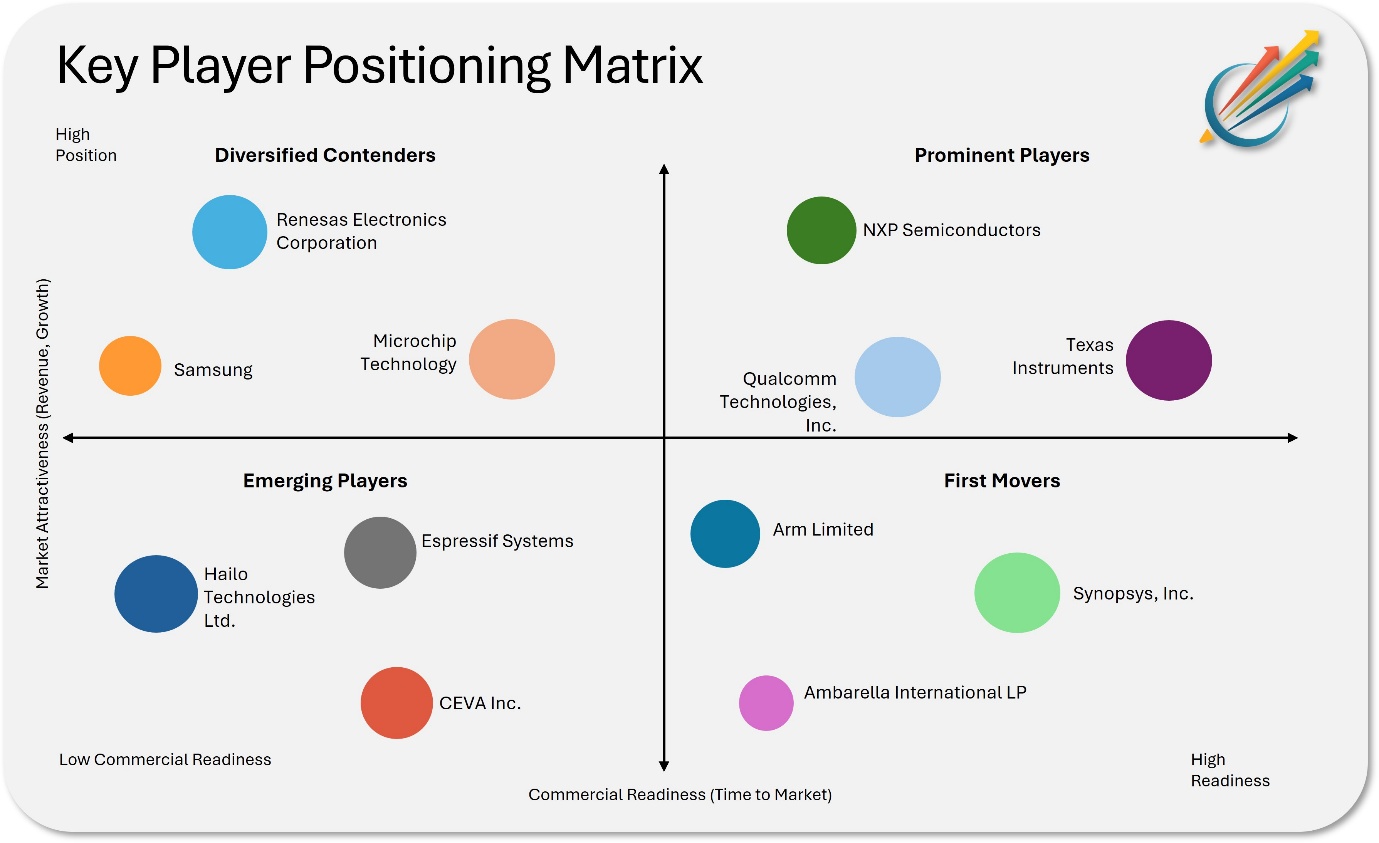
Embedded AI market is highly innovation-driven, with semiconductor manufacturers, AI software providers, technology companies, etc. are competing to develop efficient edge intelligence solutions. Leading firms are investing heavily in specialized AI processors, neural processing units, optimized development frameworks and others designed for low-power embedded environments. Collaborations between chipmakers, cloud providers, and device manufacturers are being witnessed in embedded AI market. Companies are also pursuing mergers, technology partnerships, and vertical integration across AI hardware and software stacks to strengthen their positioning and capture emerging opportunities in the rapidly expanding edge AI ecosystem.
Key Players in Embedded AI Market are
- Nvidia
- Intel
- Qualcomm Technologies, Inc.
- Arm Limited
- MediaTek
- Alphabet
- STMicroelectronics
- Advanced Micro Devices , Inc.
- Samsung
- Ambarella International LP
- Hailo Technologies Ltd.
- Synopsys , Inc.
- CEVA Inc.
- NXP Semiconductors
- Texas Instruments
- Microchip Technology
- Renesas Electronics Corporation
- Syntiant
- Espressif Systems
- Kneron Inc.
- Broadcom
- Huawei Technologies Co., Ltd.
Key Developments:
- In March 2025, Qualcomm finalized the acquisition of the TinyML software platform Edge Impulse to vertically integrate its developer ecosystem and compete with Nvidia ’s CUDA platform.
- In July 2025, Hailo began volume shipments of the Hailo-10H, an edge-AI accelerator positioned as GenAI Ready, capable of running Llama-3-8B models locally.
- In December 2025, Nvidia announced plans to acquire key assets, technology, and personnel from AI chip startup Groq for about $20 billion, strengthening its position in high-speed, low-latency AI inference.
Explore the Full Industry Intelligence Suite: https://marketmindsadvisory.com/embedded-ai-market/
Trending Related Reports
The graphic processor market is anticipated to be valued at USD 70.9 billion in 2026 and is projected to reach a value of USD 243.7 billion by 2033, witnessing an annualised growth rate of 19.3% over the forecast period.
The artificial intelligence in healthcare market is forecasted to achieve a valuation of USD 8.0 billion in 2024, soaring to USD 182.8 billion by 2034, with a staggering CAGR of 39.5% over the forecast period.
The Artificial Intelligence in Packaging Market is poised for significant expansion, driven by the rapid adoption of automation and intelligent systems across the packaging value chain.
The advanced IC substrates market is estimated to generate a revenue of USD 19.5 billion in 2026 and is projected to reach a valuation of USD 32.2 billion by 2033, witnessing an annualised growth rate of 7.4% over the forecast period.
The power semiconductor market is anticipated to be valued at USD 62.5 billion in 2026 and is forecast to reach around USD 97.1 billion by the end of forecast period, registering a CAGR of 6.5% over the period of 2026 and 2033.
The Session Border Controller (SBC) market is witnessing a steady growth, driven by emerging demand from secure and efficient VoIP communications sector.
The artificial pancreas device system (APDS) market is projected to grow robustly, reaching USD 2.2 billion in 2025 and surging to USD 3.4 billion by 2034 at a CAGR of 19.2% during the forecast period.
The animal artificial insemination market is projected to grow from USD 2.19 billion in 2024 to an impressive USD 3.92 billion by 2034, exhibiting a robust CAGR of 7.0% during the forecast period.
The ADAS market size is projected to reach USD 112.4 billion by 2033, up from USD 38.7 billion in 2026, reflecting a robust CAGR of 16.7% during the forecast period.
The advanced packaging market is poised for significant growth, driven by the increasing demand for semiconductor solutions across various industries.
Why choose Market Minds Advisory
Market Minds Advisory delivers decision-grade intelligence trusted by executives across machinery & equipment, packaging, chemical, automotive, information & communication technology, food & beverage, consumer goods, healthcare and other industries. We provide market expansion strategies, go-to-market strategies, market share acceleration, brand positioning analysis, and account enablement and growth. Our forecasting methodology integrates primary interviews, proprietary demand models and continuous market validation to ensure accuracy in volatile and emerging industries. With over 10 years of industry experience and insights derived from primary interviews with several industry stakeholders, our research provides actionable insights and white space analysis for the emerging segments providing the opportunity gaps in the market accounting recent market developments and geopolitical risks. We believe in unlocking growth by helping businesses to see the future of their markets.
Contact Us
Market Minds Advisory
86 Great Portland Street, Mayfair, London,
W1W 7FG, England, United Kingdom
T: +44 020 3807 7725
Email: sales@marketmindsadvisory.com
Website: https://marketmindsadvisory.com/
LinkedIn | Meta | Twitter | Instagram
Attachments
CONTACT: Market Minds Advisory

86 Great Portland Street, Mayfair, London,

W1W 7FG, England, United Kingdom

T: +44 020 3807 7725


| About us | Network | Partners |
| Fpgroup.nlinfo@analist.nlRSS feedContactIntellectual Property Photos |
Analist.nlLinksISIN
|
MorningstarPrudena.comAAII.comNASDAQvwd GroupEuronextBATS Chi-x |
