
Automotive Glass Market Analysis Report 2026 - Global Industry Size, Share, Trends, Opportunity, and Forecast, 2021-2031
The Global Automotive Glass Market benefits from rising vehicle production, the shift to electric vehicles, and innovations in smart and sensor-compatible glazing, despite energy and raw material cost volatility. Opportunities include lightweight, acoustic-friendly glass solutions and enhanced glass integration for autonomous driving.
Dublin, Jan. 23, 2026 (GLOBE NEWSWIRE) -- The "Automotive Glass Market - Global Industry Size, Share, Trends, Opportunity, and Forecast, 2021-2031" has been added to ResearchAndMarkets.com's offering.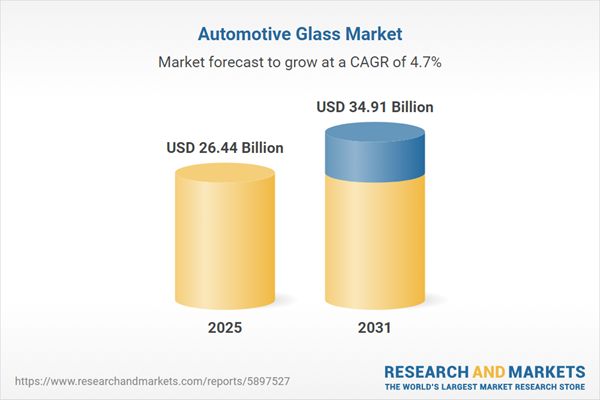
The Global Automotive Glass Market is projected to expand from USD 26.44 Billion in 2025 to USD 34.91 Billion by 2031, registering a CAGR of 4.74%
This sector involves the production of safety glazing, specifically tempered and laminated glass used for side windows, roofs, and windscreens. The primary factor sustaining this market is the steady increase in global vehicle manufacturing, which demands large volumes of original equipment manufacturer (OEM) components, alongside strict safety regulations that mandate the use of durable, shatter-resistant materials. The connection between market demand and automotive output is highlighted by recent industrial data; according to the International Organization of Motor Vehicle Manufacturers (OICA), the global automotive industry produced a total of 92.5 million motor vehicles in 2024.
Despite the growth driven by production volumes, the market faces significant hurdles due to the volatility of energy and raw material costs. Glass manufacturing is an energy-intensive process that relies heavily on commodities such as silica sand and soda ash, making producers highly sensitive to global price fluctuations. These unpredictable input costs frequently erode profit margins and complicate pricing strategies, creating financial barriers that discourage long-term investment and capacity expansion within the sector.
Market Drivers
The rapid adoption of electric vehicles is fundamentally reshaping the automotive glass industry by creating a need for components that improve energy efficiency and acoustic performance. To maximize battery range, manufacturers are prioritizing lightweight glazing solutions that lower overall vehicle mass, while also integrating acoustic interlayers to dampen cabin noise in the absence of an internal combustion engine. This transition is driven by a sharp rise in consumer uptake; according to the International Energy Agency's 'Global EV Outlook 2024' released in April 2024, global electric car sales are expected to reach approximately 17 million units in 2024.
Simultaneously, innovations in switchable glazing and smart glass are transforming standard windows into active vehicle interfaces. This trend involves embedding digital display integration and electrochromic capabilities, which significantly raises the unit value of these components compared to traditional glazing. The commercial success of these high-value technologies is reflected in supplier results; for instance, Gentex Corporation reported in January 2024 that its automotive net sales reached $2.25 billion for the 2023 calendar year, driven by a 45% increase in Full Display Mirror shipments. Furthermore, highlighting the sector's financial health during these shifts, Fuyao Glass Industry Group reported a total revenue of CNY 33.16 billion for the 2023 fiscal year in 2024.
Market Challenges
The instability of energy and raw material costs presents a severe obstacle to the Global Automotive Glass Market. Because glass manufacturing requires high-temperature processing and specific inputs like silica sand and soda ash, producers are extremely sensitive to fluctuations in commodity prices. When these input costs rise unexpectedly, manufacturers suffer immediate margin compression because rigid supply contracts often prevent them from passing these expenses on to automotive OEMs. This financial pressure disrupts cash flow and creates an uncertain operating environment, effectively discouraging the capital-intensive investments necessary for facility upgrades and capacity expansion.
This reluctance to invest directly hampers market development and leads to contraction within the sector. The negative impact of cost instability is illustrated by recent financial performance data from key manufacturing hubs. According to the Federal Association of the German Glass Industry (BV Glas), the glass industry recorded an 8.3% decline in turnover in 2024 compared to the previous year. These figures underscore how input cost volatility damages financial health, thereby preventing the market from achieving its full growth potential despite consistent demand from the automotive sector.
Market Trends
The integration of cameras, LiDAR, and ADAS sensors into glass panels is transforming the windshield into a precision optical component vital for autonomous driving. Manufacturers are now required to produce glazing that includes specific mounting brackets for forward-facing cameras while ensuring zero optical distortion to guarantee the accuracy of safety technologies. This shift toward high-value, sensor-compatible glazing is driving substantial revenue for specialized suppliers who can meet these rigorous technical standards. Highlighting the financial scale of this sector, NSG Group reported in its 'Integrated Report 2024' in October 2024 that its automotive glass segment generated revenue of approximately $2.7 billion for the fiscal year ending March 31, 2024, by prioritizing value-added products for advanced driver assistance.
Concurrently, the proliferation of glass canopy designs and panoramic sunroofs is redefining vehicle aesthetics by maximizing the glass-to-body ratio. This trend compels glassmakers to manufacture larger, complex-curved panels that often replace traditional metal roofs entirely to satisfy consumer preferences for spaciousness and natural light. This structural evolution significantly boosts the demand for reinforced, large-area glazing systems, serving as a robust commercial engine for leading roof system providers. The magnitude of this market activity is evidenced by Webasto Group, which reported in its March 2024 annual financial announcement that total sales reached nearly 4.6 billion euros for the 2023 fiscal year, underscoring the substantial demand surrounding automotive roof systems.
Key Players Profiled in the Automotive Glass Market:
- Asahi Glass Co.
- Nippon Sheet Glass
- Fuyao Group
- Xinyi Glass
- Saint Gobain
- Guardian Automotive
- Webasto
- Benson Auto Glass
- Carlex Glass
- Magna International
Report Scope: In this report, the Global Automotive Glass Market has been segmented into the following categories:
Automotive Glass Market, by Type:
- Regular Glass
- Smart Glass
Automotive Glass Market, by Application Type:
- Windshield
- Rear View Mirrors
- Sunroof
- Other
Automotive Glass Market, by Vehicle Type:
- Passenger Vehicles
- Commercial Vehicles
Automotive Glass Market, by Region:
- North America
- Europe
- Asia-Pacific
- South America
- Middle East & Africa
Key Attributes:
| Report Attribute | Details |
| No. of Pages | 180 |
| Forecast Period | 2025 - 2031 |
| Estimated Market Value (USD) in 2025 | $26.44 Billion |
| Forecasted Market Value (USD) by 2031 | $34.91 Billion |
| Compound Annual Growth Rate | 4.7% |
| Regions Covered | Global |
For more information about this report visit https://www.researchandmarkets.com/r/2nx8x9
About ResearchAndMarkets.com
ResearchAndMarkets.com is the world's leading source for international market research reports and market data. We provide you with the latest data on international and regional markets, key industries, the top companies, new products and the latest trends.
Attachment
CONTACT:
CONTACT: ResearchAndMarkets.com
         Laura Wood, Senior  Press Manager
         press@researchandmarkets.com
         For E.S.T Office Hours Call 1-917-300-0470
         For U.S./ CAN Toll Free Call 1-800-526-8630
         For GMT Office Hours Call +353-1-416-8900


| About us | Network | Partners |
| Fpgroup.nlinfo@analist.nlRSS feedContactIntellectual Property Photos |
Analist.nlLinksISIN
|
MorningstarPrudena.comAAII.comNASDAQvwd GroupEuronextBATS Chi-x |
