
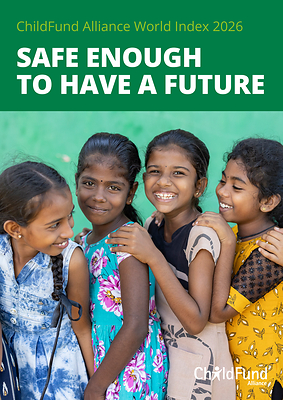
ChildFund Alliance World Index 2026: Safe Enough to Have a Future
|
ChildFund Alliance
/ Key word(s): Miscellaneous/Miscellaneous
MILAN, Nov. 17, 2026 /PRNewswire/ -- Children today are growing up amid overlapping crises: conflict, climate shocks, displacement, insecurity and inequality.
Against this backdrop, ChildFund Alliance has launched the ChildFund Alliance World Index 2026: Safe Enough to Have a Future. The report brings together two complementary components: research involving more than 3,000 children across 27 countries, exploring their lived experiences of safety, and a ranking of 134 countries assessing the implementation of children's formal rights through 30 indicators. Launched in Manila ahead of the Second Global Ministerial Conference on Ending Violence Against Children, the report explores how children experience safety and why it matters not only for their lives today, but also for their right to the future: the opportunity to imagine and pursue a future, beyond simply being protected from harm. The findings show that children who feel safe are more likely to believe they can shape their future. Yet laws and institutions do not always translate into accessible support. Protection is the system; safety is the child's lived experience of that system. "A child's right to safety must mean more than laws and policies – it must be reflected in their everyday experiences," said Tamar Manuelyan Atinc, Chair of the ChildFund Alliance Board of Directors. "Children must not only be protected – they must be heard, believed and empowered to shape their own futures." The research involved two participatory components: a survey of 2,344 children aged 8–18 across 27 countries, and Safety Mapping sessions with 834 children across 21 countries. Children mapped safe and unsafe places in their communities, identified who was responsible and suggested what should change. Key findings include:
The findings also reveal how inequalities shape children's experiences. Girls with disabilities or functional difficulties consistently report greater distress, less access to trusted adults and a narrower sense of control over their future. More broadly, girls' confidence in shaping their future is closely connected to the rights and opportunities available to women in their communities, highlighting how inequalities can be passed between generations. Despite these challenges, most children retain a sense of possibility: 67% believe they can shape their future, while 17% say "maybe" and 10% say "no." However, the findings show that safety is fundamental to maintaining this sense of agency and possibility. Alongside the report, ChildFund Alliance is releasing child-friendly versions of its findings in different languages, with activities for schools, communities and peer groups. Research is only the first step: children's participation must lead to Action . Adults must listen and respond, ensuring children's voices shape the decisions that affect them. Closing the Gap between protection and safety requires meaningful participation and systems that respond to children's needs. The right to the future begins with children who know they are heard, feel safe and believe change is possible.

17.11.2026 CET/CEST Dissemination of a Corporate News, transmitted by EQS News - a service of EQS Group. |
 View original content to download multimedia:
2436692 17.11.2026 CET/CEST

| About us | Network | Partners |
| Fpgroup.nlinfo@analist.nlRSS feedContactIntellectual Property Photos |
Analist.nlLinksISIN
|
MorningstarPrudena.comAAII.comNASDAQvwd GroupEuronextBATS Chi-x |
