
Multi Functional Packaging Market Demand Insights
Companies are moving beyond packaging optimization toward multifunctional solutions that can simultaneously address performance, sustainability, logistics and consumer expectations.
Wilmington, DE, United States, Sept. 10, 2026 (GLOBE NEWSWIRE) -- Multi-Functional Packaging Market Emerging as one of Many Strategically Valuable Layers of Modern Product Protection
Packaging used to be the last decision in a product's journey to market. That sequencing is breaking down. Across food, pharmaceuticals, and high-value goods, the package itself is being asked to extend shelf life, signal spoilage, and protect product integrity through fragmented supply chains. The multi functional packaging market sits at the center of that shift, and procurement teams accustomed to specifying packaging on price alone are working with an outdated mental model.
What is changing is not the material so much as the expectation placed on it. A package that scavenges oxygen, regulates gas exchange, or reports its own temperature history is doing work that previously required separate systems or was simply not done at all. Demand within the multi functional packaging market is being pulled by brands that have started treating packaging as a quiet contributor to product economics rather than a fixed overhead.
Request a Free Sample Report: https://marketmindsadvisory.com/request-sample/?report_id=27
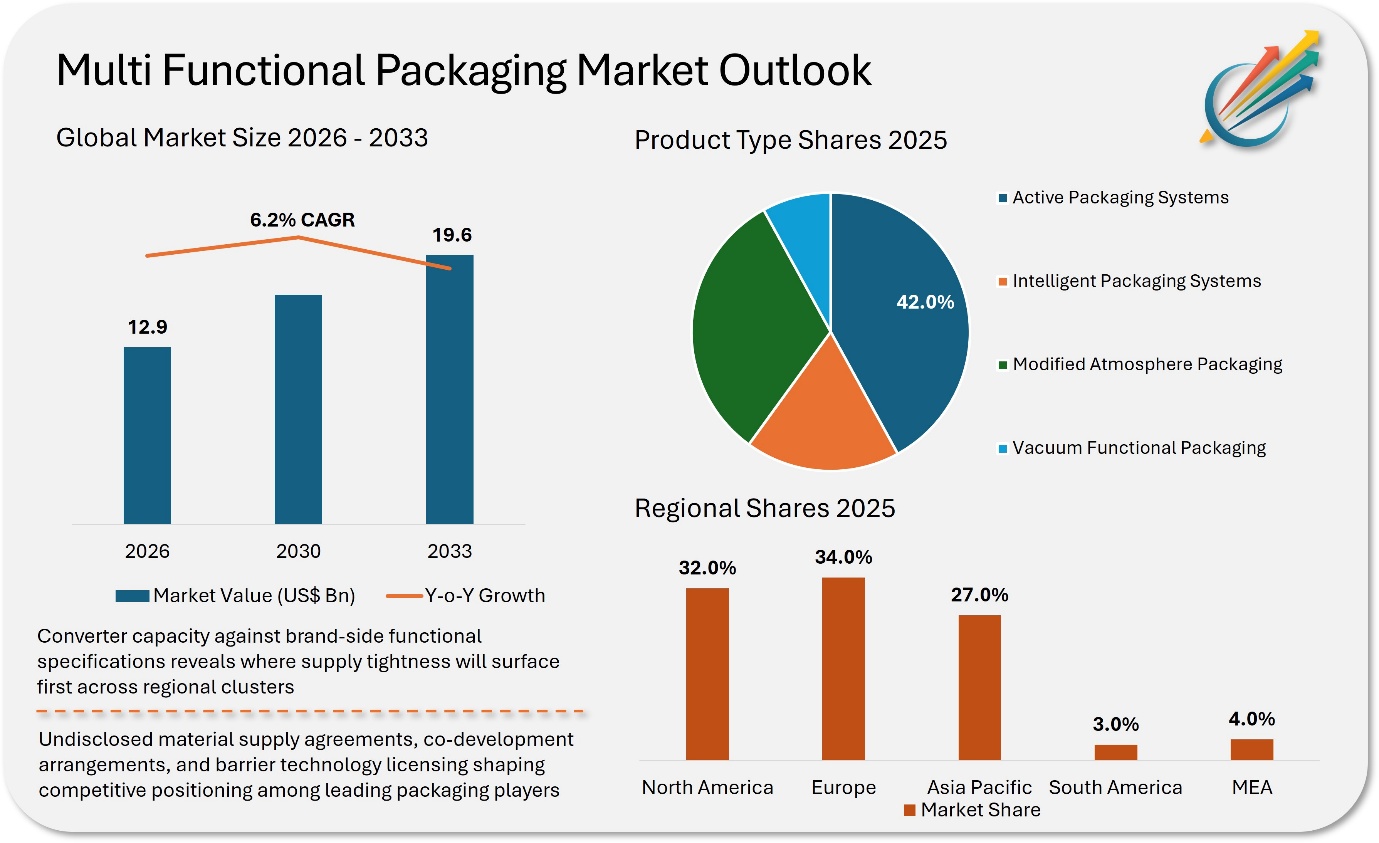
Key Takeaways from Multi Functional Packaging Market
- Multi functional packaging market valued at US$ 12.9 billion in 2026, signaling mainstream adoption across regulated sectors and is projected to reach US$ 19.6 billion by 2033 as functional specifications enter standard procurement.
- Active and intelligent packaging systems are shifting from pilot programs to scaled commercial deployment in multi functional packaging market
- E-commerce growth is driving protective functional packaging demand independent of food and pharma cycles.
- Bio based and nano enhanced materials are reframing functional performance as a sustainability advantage across multi functional packaging market.
- Pharmaceutical and medical device segments are anchoring PREMIUM pricing for compliance-grade functional formats.
As per Associate Vice President from Market Minds Advisory, " Multi functional packaging market has crossed from differentiator to baseline expectation in regulated categories, and the firms locking in material partnerships and converter capacity now will set the cost structure others inherit. The Next 18 months decide who specifies functionality and who pays a PREMIUM to retrofit it."
Early Movers Locking Qualified Converter Capacity and Material Advantage Ahead of Competitors
- Specification is moving upstream: Functional requirements that once appeared late in packaging selection are now being written into product briefs, which compresses the time converters have to qualify materials and run validation.
- Converter capacity is unevenly distributed: Capability for multi layer barrier films and active systems concentrates in a limited set of facilities, and brands without secured relationships face longer qualification queues.
-
Regulatory pull is accelerating: Pharmaceutical and food safety frameworks increasingly reward demonstrable protection and traceability, turning functional packaging from optional upgrade into a compliance-aligned decision.
Multi Functional Packaging Market Rapidly Shifting from Passive Packaging to Active Product Stewardship
The defining change is not incremental material improvement. It is a reassignment of responsibility, where the package now participates directly in preserving, monitoring, and protecting what it carries.
- Active systems are absorbing functions once handled elsewhere: Oxygen scavenging and moisture control packs reduce reliance on additives, cold-chain redundancy, and conservative shelf-life dating, which changes the economics of the whole product line.
- Intelligent packaging is converting data into decisions: Time temperature indicators and freshness signals give retailers and distributors a basis for dynamic handling, returns reduction, and waste avoidance that static packaging cannot support.
-
Material choice is becoming a strategic lever: The move toward bio based and nano enhanced functional materials means packaging selection now carries sustainability, performance, and brand consequences simultaneously, rather than performance alone.
Packaging Roadmaps still Underestimate the Speed of Structural Change across Functional Materials
Plastic-based functional packaging will retain dominant share well past the point most sustainability commentary assumes. Barrier performance, cost, and converter familiarity remain difficult to match, and bio based alternatives will grow fastest in segments where regulation or brand positioning, not pure economics, drives the decision.
Intelligent packaging adoption will be led by logistics and returns economics rather than consumer-facing freshness signaling in multi functional packaging market. The defensible value sits in supply-chain visibility and shrink reduction, where indicators pay for themselves quietly, long before shoppers notice them on shelf.
The binding constraint over the forecast period will be qualified converter capacity, not material innovation. Brands tend to assume technology is the bottleneck. In practice, access to validated production lines for active and barrier formats is what will separate fast movers from those waiting in qualification queues.
Structural Forces Reshaping the Multi Functional Packaging Market
Food waste economics
Retailers and brand owners are quantifying the cost of spoilage with more precision than before, and functional packaging is increasingly evaluated against that number rather than against plain packaging cost. When a package extends usable life or flags compromised product, it offsets losses that historically sat invisibly inside margin. That reframing moves functional formats from discretionary spend toward measurable return, and it is changing how packaging budgets get defended internally.
E-commerce protective demand
Direct-to-consumer shipping exposes products to handling stress that traditional retail packaging never anticipated. Shock absorption, barrier protection, and tamper evidence have become baseline requirements for goods moving through parcel networks. This demand stream grows on its own logic, largely decoupled from food and pharmaceutical cycles, and it gives the multi functional packaging market a second structural engine that did not meaningfully exist a decade ago.
Pharmaceutical compliance pressure
Tightening serialization, stability, and traceability expectations are pushing pharmaceutical and medical device packaging toward formats that actively protect and document product condition. Functional packaging here is less a competitive choice than a regulatory necessity. That dynamic anchors PREMIUM pricing and rewards converters who can demonstrate validated, audit-ready capability rather than competing primarily on unit cost.
Material innovation convergence
Bio based polymers, nano enhanced barriers, and fiber-based functional substrates are maturing at roughly the same time, and they are converging on the same problem set. The result is a widening menu of ways to deliver antimicrobial Action , gas regulation, or thermal protection. Brands now choose not just whether to add function, but which material story to attach to it.
Ignoring Structural Risks Could Delay Competitive Positioning across Consumer and Pharmaceutical Packaging Markets
- Cost PREMIUM resistance: Functional formats carry higher unit costs, and price-sensitive categories may defer adoption until savings elsewhere are clearly demonstrated.
- Recycling complexity: Multi layer and nano enhanced structures complicate recyclability, creating friction with extended producer responsibility regimes and brand sustainability commitments.
- Validation timelines: Regulated applications require lengthy qualification, slowing the pace at which functional packaging converts from interest to purchase orders.
- Material supply concentration: Specialized barrier resins and active agents depend on a narrow supplier base, exposing buyers to availability and pricing volatility.
- Fragmented standards: Inconsistent regional rules on active and intelligent packaging raise compliance cost and complicate multi-market product launches.
- Technology integration risk: Smart labels and indicators must perform reliably across variable conditions, and field failures can erode trust faster than successes build it.
These constraints are real and will shape the pace of adoption, but none reverse the underlying direction. They affect timing and sequencing rather than the structural conclusion that functional performance is becoming standard.
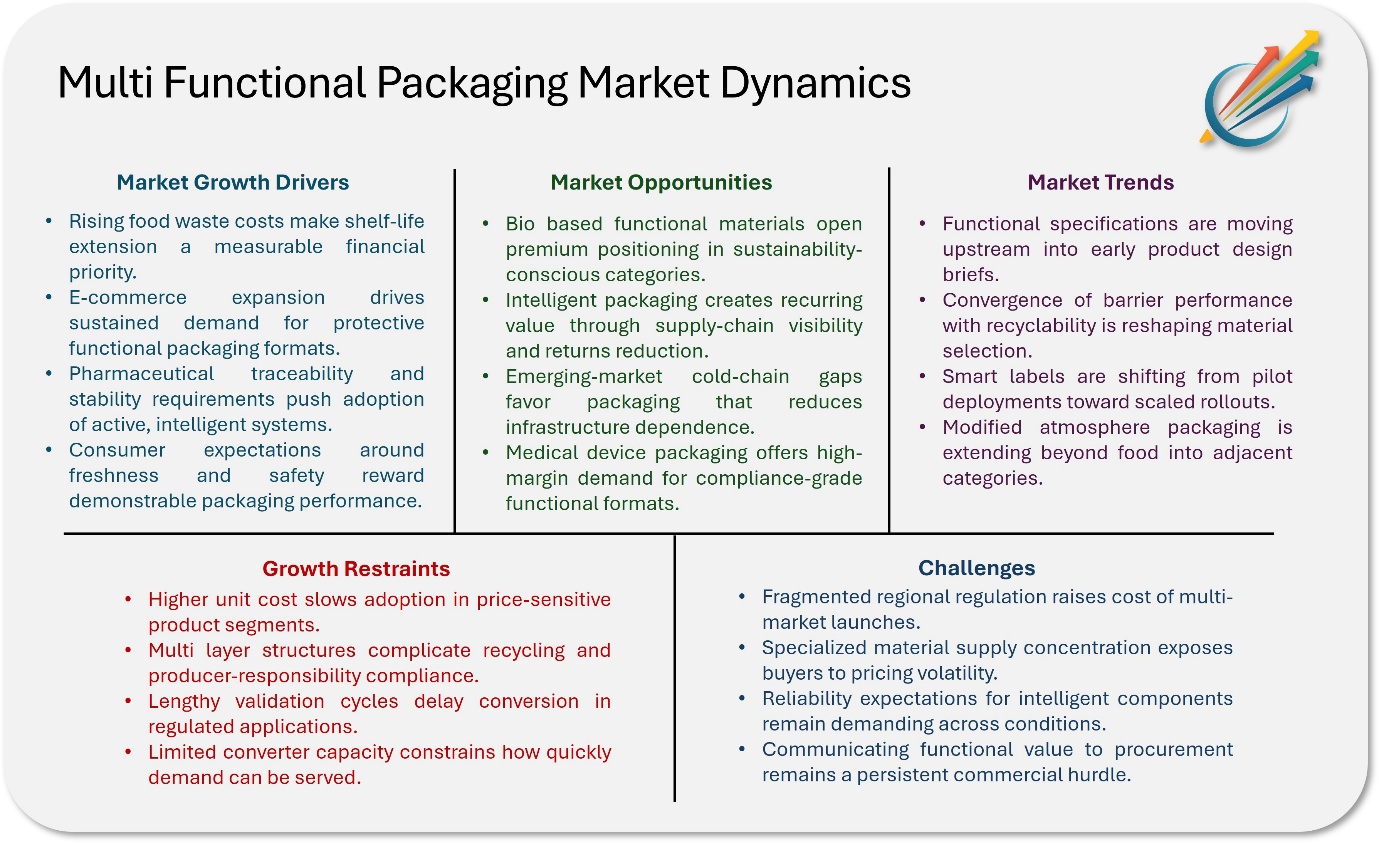
Market Dynamics Shaping the Multi Functional Packaging Market
Multi Functional Packaging Market Segmentation
By Packaging Type
- Flexible Multi Functional Packaging
- Multi Layer Films
- Laminated Pouches
- Barrier Wraps
- Rigid Multi Functional Packaging
- Multi Compartment Containers
- Smart Bottles
- Functional Trays
- Semi Rigid Packaging
- Clamshell Packs
- Blister Packs
Flexible formats hold the largest share because multi layer films and laminated pouches deliver barrier performance at favorable cost and weight. Rigid functional packaging is gaining ground where structural protection and reuse matter, particularly in beverages and PREMIUM goods. Semi rigid formats remain anchored in pharmaceutical blister applications all over multi functional packaging market. The competitive question across this category is less about format preference and more about which converters can validate functional layers at scale within the multi functional packaging market.
By Product Type
- Active Packaging Systems
- Oxygen Scavenging Packs
- Moisture Control Packs
- Ethylene Absorbing Packs
- Intelligent Packaging Systems
- Time Temperature Indicators
- Freshness Indicators
- Smart Labels
- Modified Atmosphere Packaging
- Vacuum Functional Packaging
Active packaging currently represents the most commercially mature segment, with oxygen and moisture control widely deployed across food categories in the multi functional packaging market. Intelligent systems are earlier in their adoption curve but carry the steepest growth trajectory as logistics economics improve their payback. Modified atmosphere and vacuum formats remain dependable contributors. The segment dynamic worth watching is the gradual blending of active and intelligent functions within single packaging systems.
By Material Type
- Plastic-based
- Paper and Fiber Based
- Aluminum
- Bio Based Functional Materials
- Nano Enhanced Materials
Plastic-based materials dominate due to barrier capability, cost, and converter familiarity, and that position will erode only gradually across multi functional packaging market. Paper and fiber based options are advancing where recyclability outweighs absolute barrier performance. Aluminum retains a defensible role in high-barrier pharmaceutical use. Bio based and nano enhanced materials, though smaller today, attract disproportionate strategic attention because they address performance and sustainability pressures at once.
By Function
- Anti Microbial
- Gas Regulation
- Thermal Insulation
- Shock Absorption
- Others
Gas regulation and antimicrobial functions carry the strongest demand because they Connect Group directly to shelf-life extension and food safety outcomes. Thermal insulation is increasingly relevant as cold-chain and pharmaceutical shipping expand. Shock absorption has been pulled forward sharply by e-commerce distribution. Function-led specification is becoming the more meaningful lens for buyers, often outranking format and material as the starting point for packaging decisions across multi functional packaging market.
By Application
- Food Preservation Packaging
- Pharmaceutical Protection Packaging
- Beverage Functional Packaging
- E Commerce Protective Packaging
- Medical Device Packaging
- Industrial Product Packaging
Food preservation remains the largest application by volume, with functional formats addressing waste and freshness at scale. Pharmaceutical and medical device packaging deliver the highest value per unit, driven by compliance requirements all over multi functional packaging market. E-commerce protective packaging is the fastest-rising application, expanding on logistics demand alone. Beverage and industrial applications provide steady, less cyclical demand that balances the overall application mix.
Shape this report around your priorities: https://marketmindsadvisory.com/request-customization/?report_id=27
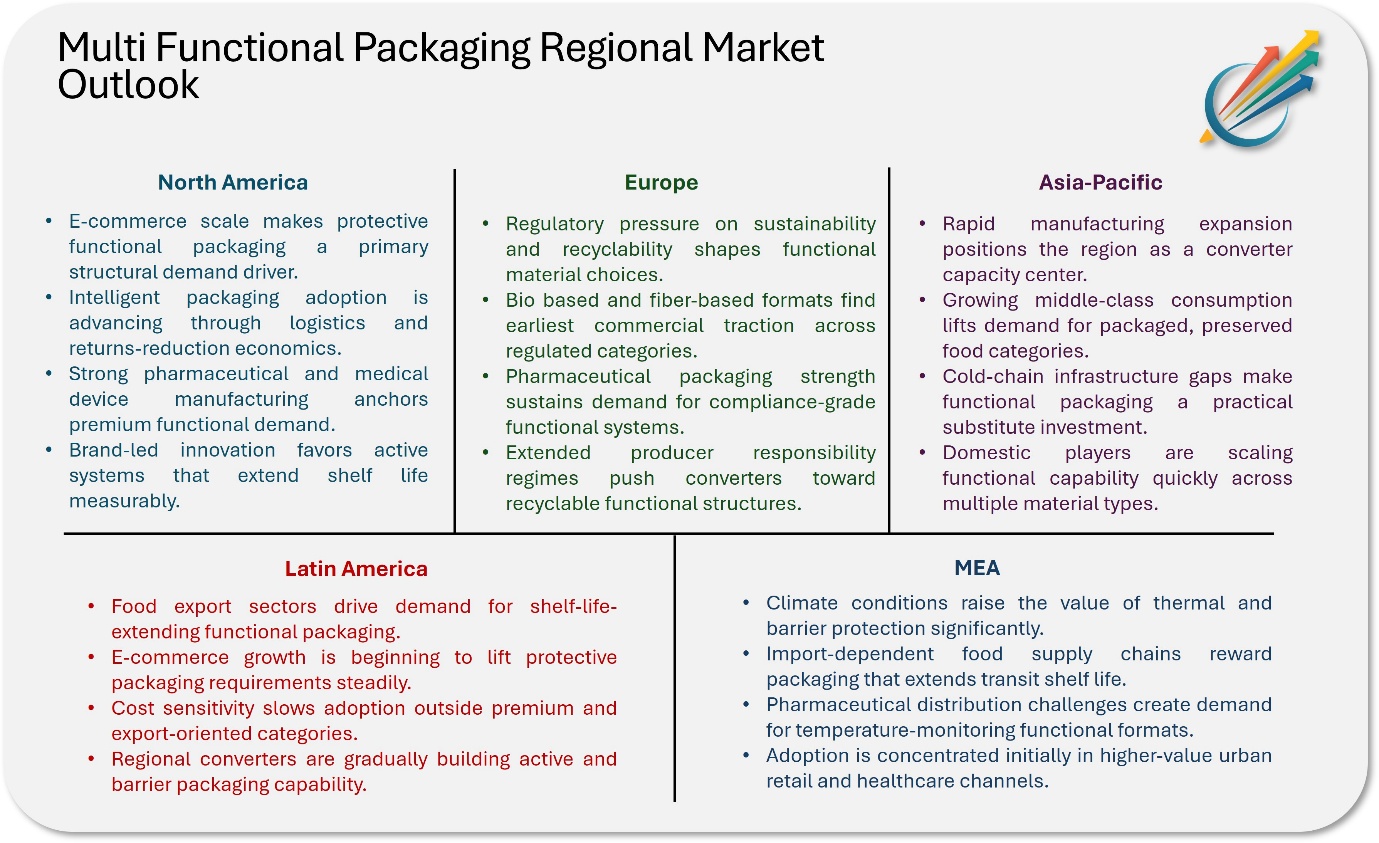
Regional Market Outlook
Investment Focus where the Lucrative Opportunity is Anticipated
Validated converter capacity
The most defensible position in the multi functional packaging market is not material ownership but qualified production capability. Converters with validated lines for active and barrier formats hold scarce, hard-to-replicate assets. As specification moves upstream, this capacity becomes the binding constraint, and the firms that control it capture pricing power others cannot easily contest.
Intelligent packaging data layers
Value in intelligent packaging is migrating from the indicator itself toward the data and decisions it enables. Companies that Connect Group time-temperature and freshness signaling to logistics and returns systems build recurring relationships rather than one-time component sales. This intersection rewards integration capability over hardware alone.
Bio based functional materials
Material developers that solve the performance-versus-sustainability tradeoff occupy a structurally advantaged position. Brands facing recyclability pressure will pay for functional performance that does not compromise environmental claims. Early movers with proven, scalable bio based barriers stand to lock in design-in relationships ahead of broader adoption.
Pharmaceutical-grade specialization
Compliance-driven pharmaceutical and medical device packaging offers the clearest PREMIUM -margin opportunity. Validation barriers are high, which deters casual competition and protects incumbents. Firms that invest in audit-ready, regulation-aligned functional capability secure demand that is durable, less price-sensitive, and difficult for new entrants to displace.
What This Means for Decision-Makers
Brand Owners and CPG Companies - Treat functional packaging as a product-economics decision rather than a procurement line. Specifying performance early, and securing converter relationships before capacity tightens, protects both cost and launch timelines.
Packaging Converters - Validated capacity for active and barrier formats is becoming the scarce asset. Investment in qualification and audit-ready capability now positions converters to capture pricing power as specification demand moves upstream.
Investors - The defensible positions are qualified converter capacity, intelligent packaging data integration, and pharmaceutical-grade specialization. These offer clearer risk-return profiles than broad exposure to packaging volume alone.
Material Suppliers - The opportunity sits in solving performance and sustainability together. Suppliers with scalable bio based and nano enhanced functional materials can lock in design-in relationships that are difficult for competitors to dislodge later.
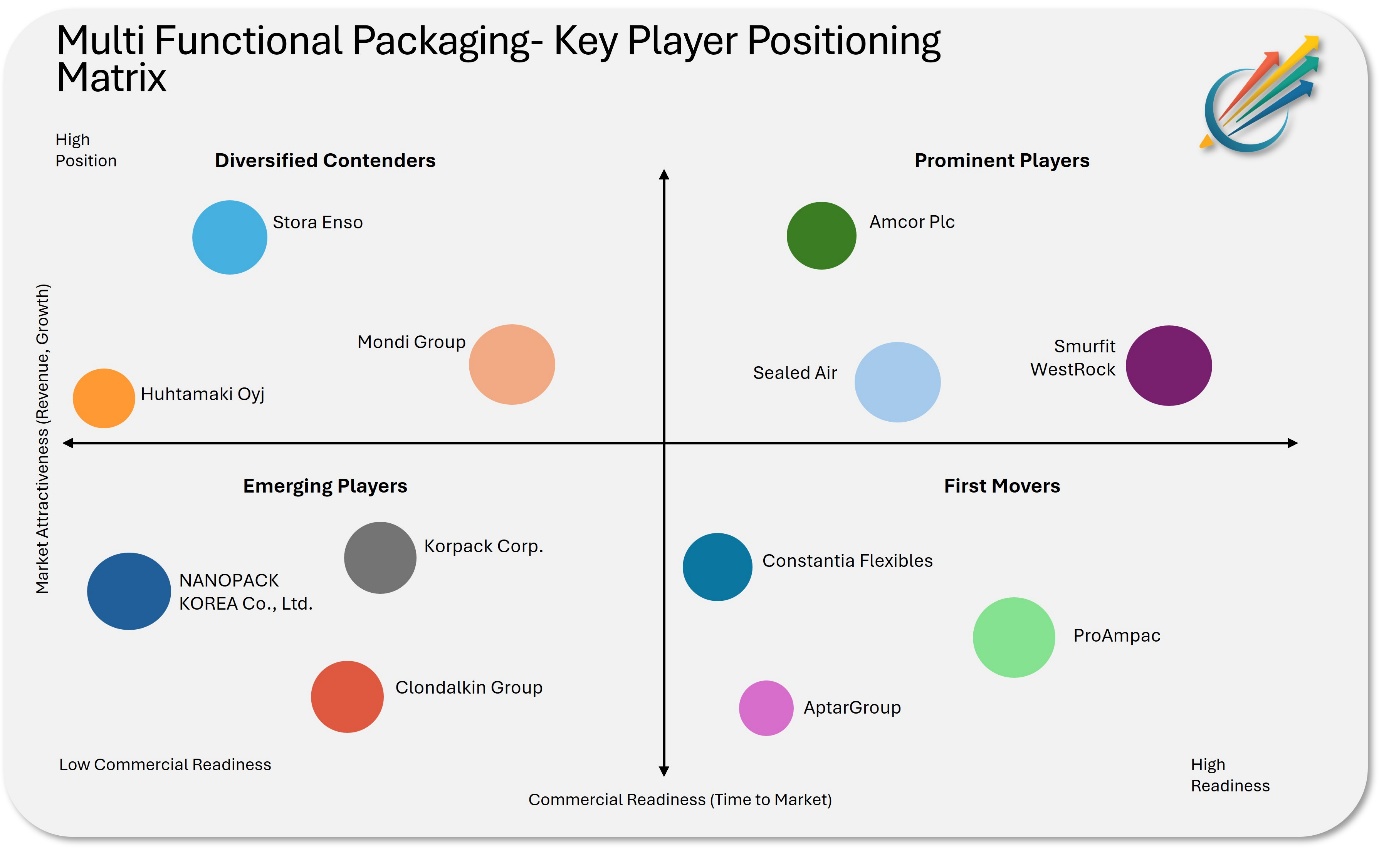
Competitive Landscape: Multi Functional Packaging Market
Recent Market Developments
- In April 2026, Amcor Plc expanded its portfolio of more recyclable functional packaging solutions aimed at food and healthcare applications.
- In March 2026, Sealed Air advanced its automation and protective packaging offerings for e-commerce and fulfillment customers.
- In February 2026, Mondi Group continued investment in paper-based and barrier packaging capacity across its European operations.
- In January 2026, Aptargroup strengthened its active packaging and material science capability for pharmaceutical and consumer health applications.
Market is segmented by Packaging Type (Flexible, Rigid, Semi Rigid), Product Type (Active Packaging Systems, Intelligent Packaging Systems), Material Type (Plastic-based, Paper and Fiber Based), and Application (Food Preservation, Pharmaceutical Protection, E-Commerce Protective Packaging)
Get Access to complete Analysis, Buy Now: https://marketmindsadvisory.com/buy-now/?report_id=27
Trending Related Reports
- Cryoboxes Market
- Crimp Top Cap Market
- Cosmetic Vials Market
- Cosmetic Jars Market
- Craft Bags Market
- Counter Bags Market
- Corrugated Plastic Trays Market
- Corrugated Paper Machine Market
- Corrugated Automotive Packaging Market
- Compostable Plastic Packaging Market
Why choose Market Minds Advisory
Market Minds Advisory delivers decision-grade intelligence to executives across machinery, packaging, chemicals, automotive, ICT , food and beverage, consumer goods, and healthcare. We help organizations sharpen market expansion strategies, accelerate share gains, refine brand positioning, and enable account-level growth. Our forecasting integrates primary interviews, proprietary demand models, and continuous market validation, producing the kind of clarity volatile and emerging industries require. Backed by over a decade of sector expertise, our research surfaces white space, opportunity gaps, and competitive blind spots, accounting for recent developments and geopolitical risk. We help businesses see the future of their markets.
Contact Us
Market Minds Advisory
1521 Concord Pike, Suite 301
Wilmington, DE 19803
United States
Email: sales@marketmindsadvisory.com
Website: https://marketmindsadvisory.com/


| About us | Network | Partners |
| Fpgroup.nlinfo@analist.nlRSS feedContactIntellectual Property Photos |
Analist.nlLinksISIN
|
MorningstarPrudena.comAAII.comNASDAQvwd GroupEuronextBATS Chi-x |
