
Small Modular Reactors (SMRs) Market Demand Insights Innovation
The SMR race is no longer about proving nuclear can be smaller, it is about who can make it bankable, licensable and deployable at scale before the market consolidates.
Wilmington, DE 19803 United States, Sept. 07, 2026 (GLOBE NEWSWIRE) -- Small Modular Reactors are Becoming the Most Contested Energy Asset of the Decade
The narrative around Small Modular Reactors has shifted faster than most strategy teams have absorbed. What was framed as a 2035 conversation two years ago is now driving site reservations, sovereign supply agreements, and hyperscaler offtake commitments that close in quarters, not decades. The buyers moving first are not utilities. They are technology companies, defense agencies, and industrial operators with load profiles that renewables alone cannot serve.
Beneath the headline announcements sits a more consequential reality. Manufacturing slots at qualified fabrication facilities are being claimed years ahead of regulatory clearance, and the queue is forming around a small number of approved designs. Organizations still treating SMRs as an emerging technology are negotiating against counterparties treating them as a near-term procurement question, and that asymmetry is now the defining feature of the market.
Request Free Sample Report: https://marketmindsadvisory.com/request-sample/?report_id=25
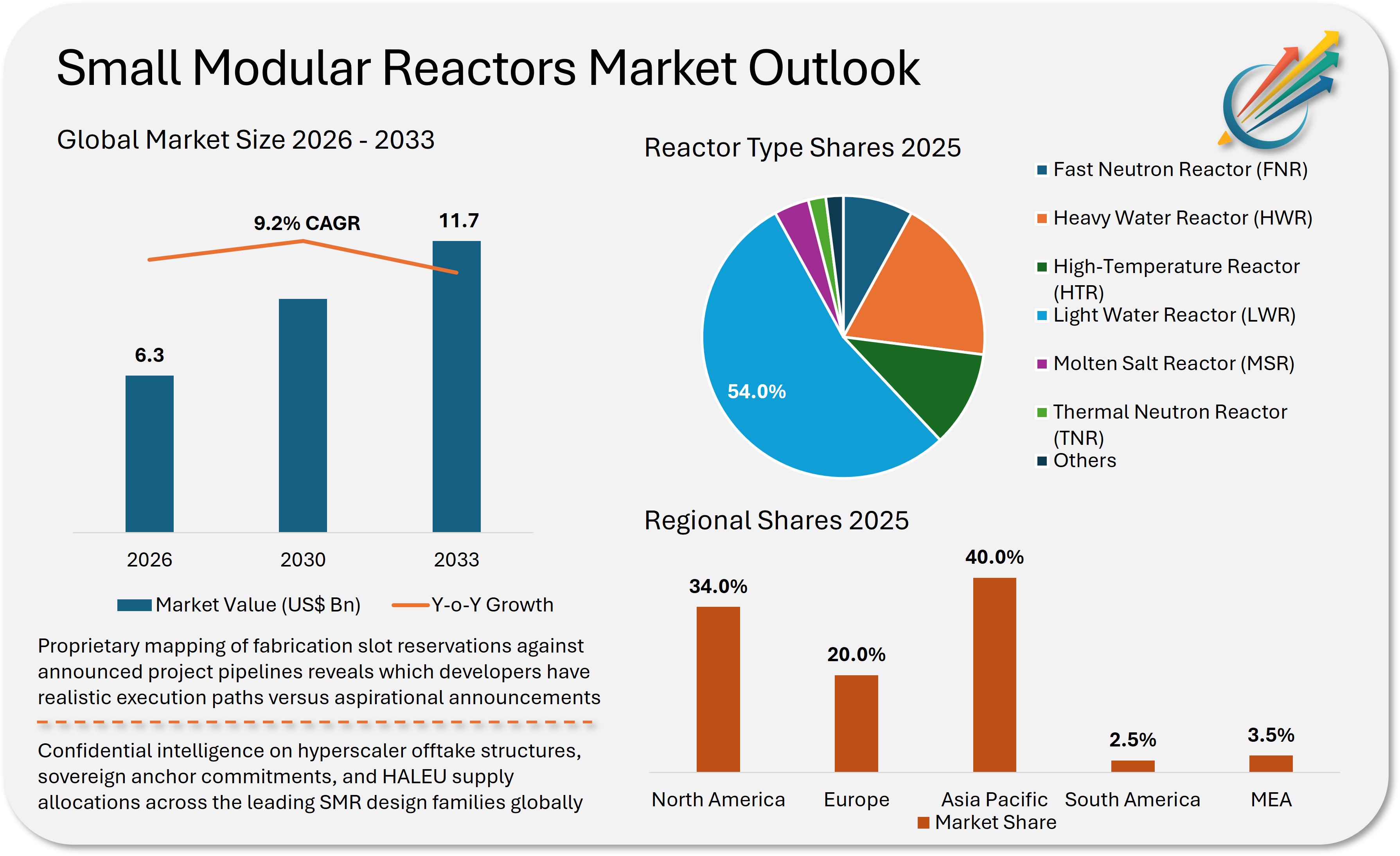
Key Takeaways from Small Modular Reactors Market
- Global small modular reactors market projected to reach US$ 11.7 billion by 2033
- Market expanding at a 9.2% CAGR from 2026 to 2033, starting at US$ 6.3 billion
- Hyperscaler data center demand has emerged as the most aggressive offtake category
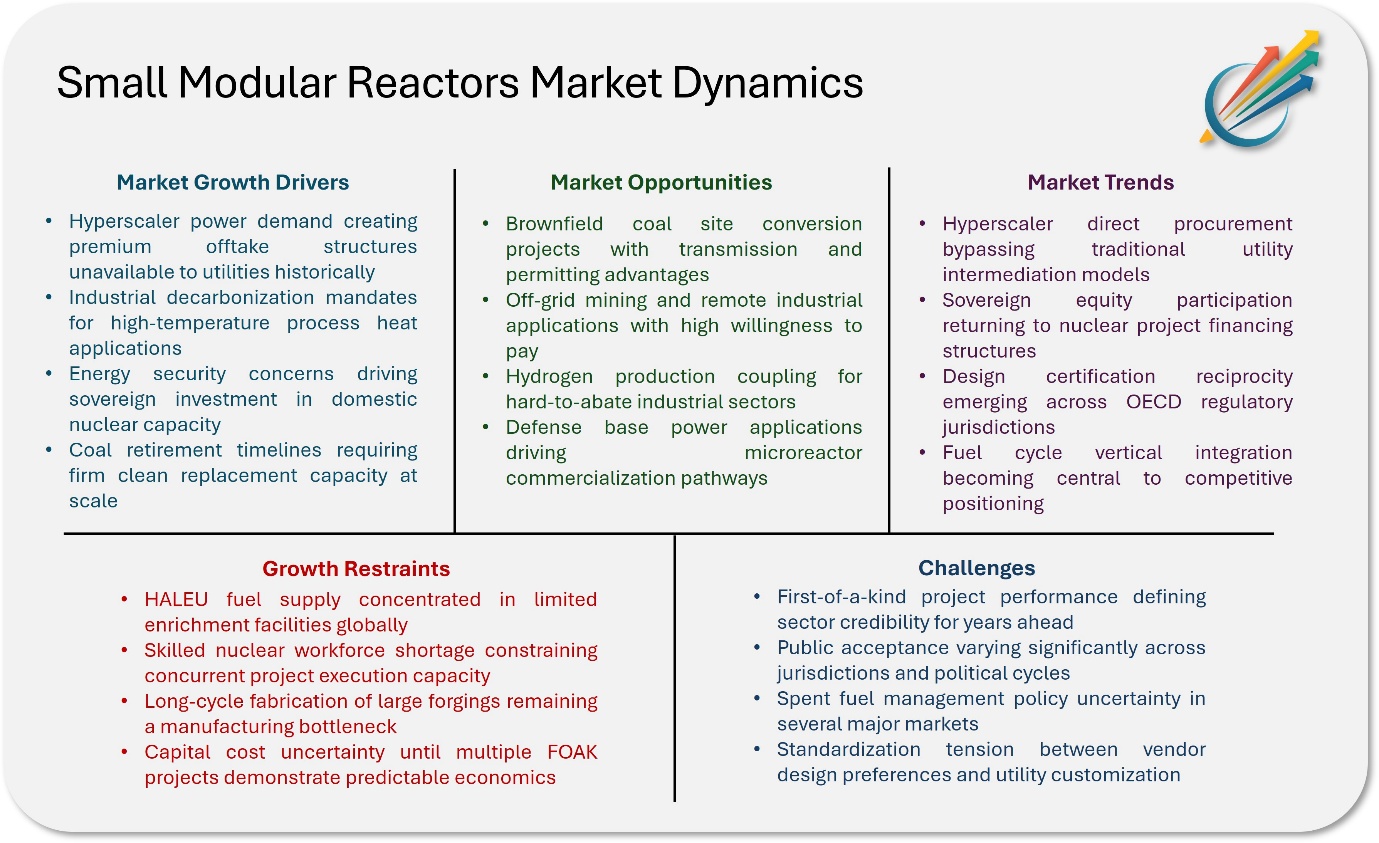
- First-of-a-kind cost overruns remain the binding constraint on commercial deployment
- Factory-built transportable modules are reshaping project economics versus traditional builds
- Regulatory harmonization across OECD jurisdictions is compressing licensing timelines materially
- Fuel supply for HALEU-dependent designs is the most underestimated bottleneck
According to Research Manager from Market Minds Advisory, " The SMR conversation has moved from technology validation to industrial execution, and the companies that lock fabrication capacity and fuel supply over the Next 2-3 years will set the cost curve for the Next two decades. Latecomers will compete on terms structurally less favorable than those available today."
Strategic Window Why the Next Eight Quarters Will Define Two Decades of Deployment Economics
- Fabrication capacity is being privately reserved: Limited qualified manufacturing facilities exist worldwide for SMR pressure vessels and reactor internals. Reservations are now closing for delivery slots in the early 2030s, well ahead of public announcements.
- Fuel supply is the silent gating factor: HALEU production capacity remains concentrated in a handful of facilities. Designs dependent on this fuel are competing for allocations that will determine which projects achieve commercial operation.
-
Regulatory pathways are bifurcating: Jurisdictions moving toward design certification reciprocity are pulling capital and projects toward them. The Gap between fast-track and conventional licensing geographies is widening with each quarter.
Critical Market Inflection as Demand Side has Restructured around Non-Utility Buyers
The buyer composition for SMR capacity looks fundamentally different from what utility-led forecasts assumed three years ago. Hyperscalers, industrial heat users, and defense procurement now represent a meaningful share of announced offtake intent.
- Hyperscaler offtake reshaping economics: Data center operators are signing power purchase commitments with credit profiles that change the financing calculus. These contracts are enabling FOAK projects that pure utility offtake could not support.
- Industrial heat decarbonization moving from concept to procurement: Chemical, steel, and refining operators are evaluating SMRs as the only credible high-temperature heat solution at scale. RFP activity has accelerated noticeably across European and North American industrial clusters.
-
Sovereign anchor commitments returning to the market: Several governments are providing direct procurement guarantees or equity participation, addressing the FOAK financing Gap that stalled deployment in the previous cycle.
Strategic Outlook Market Realities that Diverge from Consensus Expectations
The majority of announced SMR projects will not reach commercial operation by 2032. Announcement pipelines significantly exceed realistic fabrication capacity, qualified workforce, and HALEU fuel availability. Identifying the projects with secured supply chains is now the more decisive analytical question than counting MOUs.
Microreactors will commercialize ahead of medium SMRs in revenue terms. Off-grid mining, defense, and remote industrial applications offer higher willingness to pay and lower regulatory complexity. The conventional view that scale economics favour larger units understates how decisive deployment speed has become.
Two or three design families will capture disproportionate market share by 2030. Capital is consolidating around a narrower set of approved designs than current pipeline diversity suggests. Late-stage developers without secured fabrication partnerships will face structural disadvantages that capital alone cannot solve.
Structural Forces Reshaping the Competitive Boundaries of Nuclear Power
Factory fabrication economics replacing site construction risk
The shift from stick-built construction to factory-fabricated modules transforms the risk profile that historically penalized nuclear projects. Capital cost predictability, schedule certainty, and serial production learning curves are creating an economic logic distinct from conventional reactors. Companies with secured fabrication capacity are positioning for cost advantages that compound across each successive unit delivered.
Hyperscaler load growth changing demand fundamentals
AI-driven data center expansion has produced power demand growth at scales that renewable build-out cannot match within hyperscaler timelines. SMRs offer the combination of firm baseload, behind-the-meter siting, and clean attributes that match hyperscaler procurement criteria precisely. This buyer segment was not in any serious 2022 forecast and now drives a meaningful share of FOAK economics.
Fuel cycle integration becoming a strategic moat
HALEU supply, fabrication, and back-end management are emerging as competitive advantages distinct from reactor design itself. Players with vertically integrated fuel positions or sovereign supply relationships are commanding PREMIUM economics. The fuel cycle, long treated as an operational concern, has become a primary determinant of project bankability.
Shape this report around your question: https://marketmindsadvisory.com/request-customization/?report_id=25
Brownfield siting accelerating deployment timelines
Retiring coal plants and existing nuclear sites offer transmission interconnection, water rights, and community acceptance that greenfield projects cannot replicate quickly. The race to secure attractive brownfield sites is well advanced, and the inventory of suitable locations is finite. Site control is now a leading indicator of which developers can actually execute.
Risk Assessment Material Headwinds That Could Moderate Deployment Pace
- First-of-a-kind cost performance: FOAK projects remain exposed to budget and schedule overruns that could damage sector credibility if early units underperform expectations significantly.
- HALEU supply concentration: Limited enrichment capacity creates a single point of failure for advanced reactor designs dependent on this fuel category.
- Regulatory pace asymmetry: Slower licensing jurisdictions risk losing project capital and qualified suppliers to faster-moving competitor regions over the medium term.
- Public acceptance reversal: A serious incident at any nuclear facility globally could compress political support and slow permitting across multiple jurisdictions simultaneously.
- Workforce and skilled labor shortage: Qualified nuclear construction and operations talent is scarce, and pipeline development has not kept pace with project announcements.
- Cost competitiveness against firmed renewables: Rapidly falling battery storage costs could narrow the economic case for SMRs in certain grid applications.
These risks are real and material, but the directional conclusion holds. The structural drivers pulling demand toward SMRs are stronger than the factors that could plausibly reverse the trajectory.
Market Dynamics Shaping the Small Modular Reactors Market
Small Modular Reactors Market Segmentation
By Electrolyzer Type
- Fast Neutron Reactor (FNR)
- Heavy Water Reactor (HWR)
- High-Temperature Reactor (HTR)
- Light Water Reactor (LWR)
- Molten Salt Reactor (MSR)
- Thermal Neutron Reactor (TNR)
- Others
Light Water Reactors retain the dominant share of near-term deployment given regulatory familiarity and operational track record. High-Temperature Reactors are positioning aggressively for industrial heat and hydrogen applications where LWR thermodynamics are insufficient. Molten Salt and Fast Neutron designs represent the most consequential long-term technology bets, with commercialization timelines pushing into the late 2020s. The technology mix that ultimately scales will be narrower than current pipeline diversity suggests.
By Power Rating
- Microreactors (< 10 MW)
- Small SMRs (10–50 MW)
- Medium SMRs (50–300 MW)
- Large SMR Modules (300–500 MW)
- Multi-Module Plants (Aggregated > 500 MW)
Medium SMRs in the 50 to 300 MW range capture the largest share of utility-scale and hyperscaler offtake intent. Microreactors are commercializing faster in revenue terms due to lower regulatory complexity and PREMIUM pricing in remote applications. Multi-module plants represent the long-term gigawatt-scale opportunity but depend on early single-module deployment success. Power rating selection is increasingly driven by buyer load profile rather than technology vendor preference.
By Connectivity
- Grid-Connected
- Off-Grid
Grid-connected deployments dominate announced project volumes, particularly in coal replacement and capacity expansion contexts. Off-grid applications, though smaller in MW terms, generate disproportionately attractive unit economics due to the absence of competing energy alternatives. The off-grid segment is the more interesting near-term commercial Frontier Communications despite receiving less analytical attention. Many hyperscaler campus deployments will functionally operate as off-grid even when technically interconnected.
By Deployment
- Factory-Built Transportable Modules
- On-Site Assembled Modules
- Containerized/Mobile Microreactors
- Floating/Offshore SMR Deployment
- Underground / Embedded Installations
Factory-built transportable modules represent the most economically transformative deployment model, embedding manufacturing learning curves directly into project costs. On-site assembled modules retain advantages for larger units where transportation logistics constrain factory completion. Floating and offshore deployment is an underappreciated niche with strong applicability for coastal data center and industrial loads. Containerized microreactors will likely commercialize ahead of larger formats in revenue terms.
By Location
- Onshore Utility Sites
- Brownfield Nuclear Sites
- Off-Grid Locations
- Industrial / Mining Sites
- Offshore Platforms
Brownfield nuclear sites command PREMIUM project economics due to existing licensing, transmission, and community acceptance. Coal retirement sites are emerging as the Next -most-attractive category, particularly across North America and parts of Europe. Industrial and mining sites are driving microreactor commercialization where grid power is unavailable or unreliable. Site control is now a leading indicator of credible project execution, and attractive inventory is depleting faster than commentary suggests.
By Application
- Power Generation
- District Heating and Cogeneration
- Industrial Process Heat
- Desalination and Water Treatment
- Hydrogen Production
- Data Center & HPC Power Supply
- Defense Power Applications
Power generation remains the dominant application by volume, but data center power supply has emerged as the most strategically consequential category. Industrial process heat applications carry the highest willingness to pay among current buyer categories. Hydrogen production coupling represents a substantial future opportunity dependent on green hydrogen policy frameworks. Defense applications, though smaller in scale, are driving microreactor regulatory pathways that will Benefit civilian deployment subsequently.
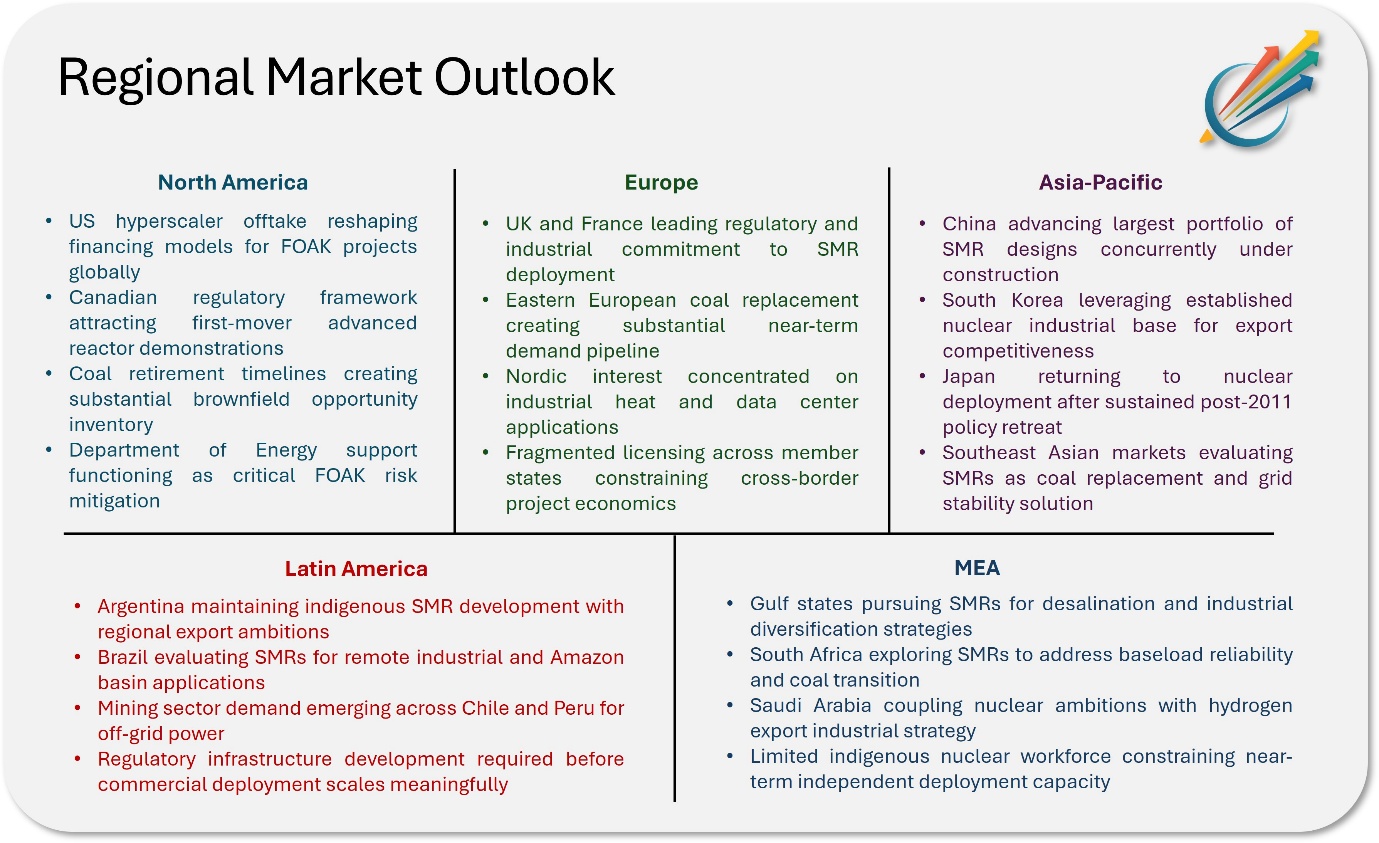
Regional Market Outlook
Investment Focus Where the Most Defensible Value is Concentrating
Fabrication capacity ownership
Companies with secured access to qualified pressure vessel and reactor internals fabrication are positioning at the binding constraint of the entire industry. The capital required to expand qualified fabrication is substantial, and lead times are measured in years. This represents the most defensible position in the value chain for the remainder of this decade.
Fuel supply integration
Vertically integrated fuel cycle positions, particularly in HALEU enrichment and fabrication, are emerging as the second-most-defensible value pool. Customers will pay material premiums for fuel supply certainty given the limited number of qualified suppliers globally. Strategic equity partnerships with enrichment capacity holders carry substantial Option value.
Brownfield site portfolios
Developers controlling attractive brownfield sites with transmission, water, and community acceptance hold scarce optionality. Site portfolios can be monetized through multiple project structures including direct development, joint ventures, and outright sale to utility or hyperscaler buyers. Site inventory is a finite asset that current valuations underestimate.
Hyperscaler-aligned development platforms
Project developers with established hyperscaler offtake relationships command financing terms unavailable to traditional utility-focused developers. The credit quality of hyperscaler counterparties combined with their willingness to pay PREMIUM prices for clean firm power creates a fundamentally different risk-return profile. This positioning is rapidly being claimed.
What This Means for Decision-Makers
Energy Utilities - The procurement decision window is narrower than internal planning cycles assume. Utilities not engaged in design selection and fabrication slot reservation conversations within the Next 18 months will face materially worse economics on units delivered in the early 2030s.
Industrial manufacturers - SMRs represent the only credible pathway to deep decarbonization for high-temperature process heat applications. Anchor offtake commitments now offer capacity certainty and pricing terms that will not be available once hyperscaler demand fully prices into the market.
Investors - Pure technology bets carry binary outcome risk that diversified positioning can largely avoid. Fabrication capacity, fuel cycle assets, and brownfield site portfolios offer more defensible risk-return profiles than backing single reactor design vendors at this point in the cycle.
Policymakers - Regulatory pace is now a determinant of industrial competitiveness. Jurisdictions that fail to advance design certification reciprocity and licensing predictability over the Next two years will lose project capital, qualified suppliers, and skilled workforce to faster-moving competitor regions.
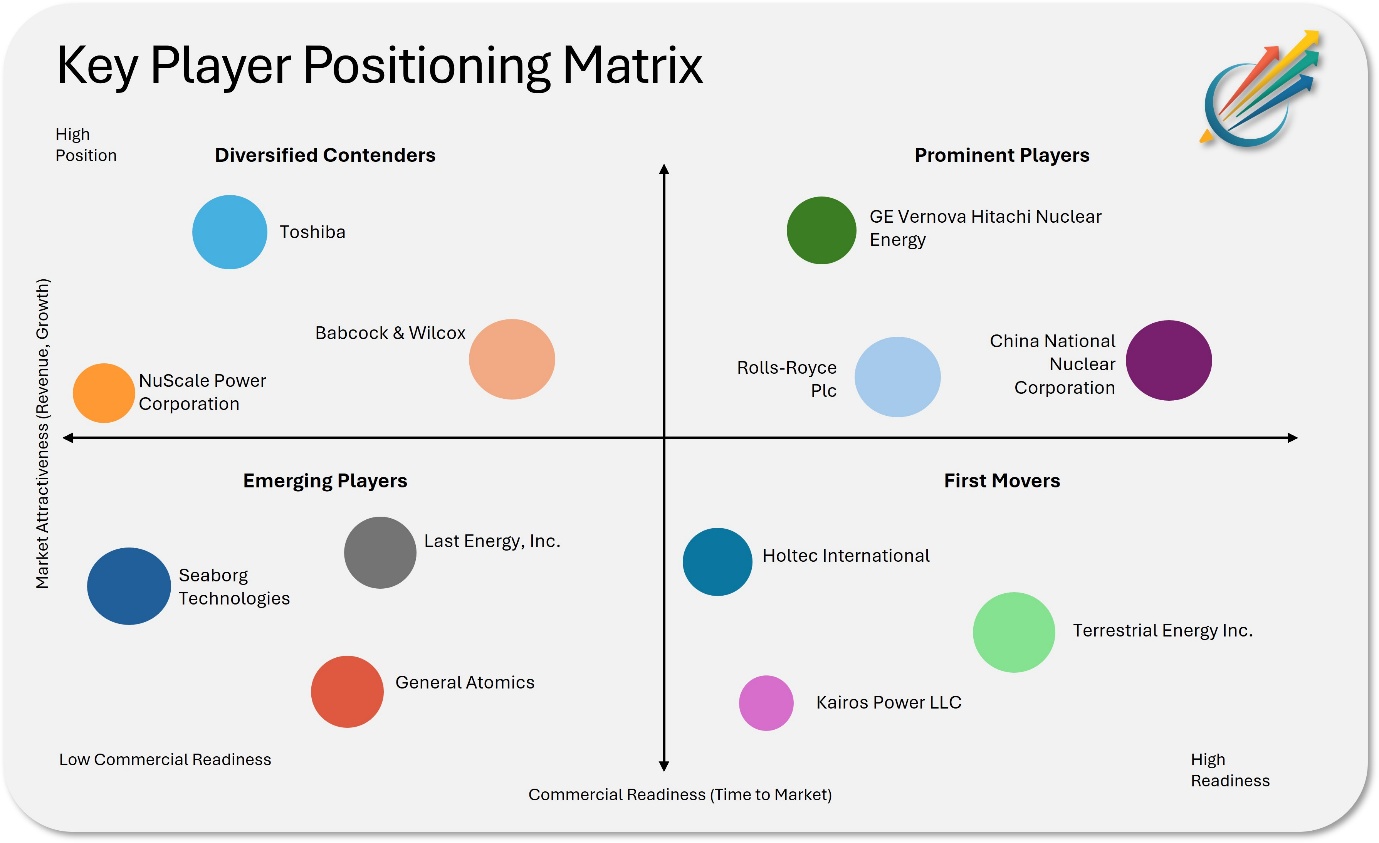
Competitive Landscape – Small Modular Reactors Market
Recent Market Developments
- In April 2026, NuScale Power Corporation advanced Engineering work on its VOYGR plant configuration in coordination with utility partners targeting late-decade commercial operation.
- In February 2026, X energy, LLC progressed development activities on its Xe-100 high-temperature reactor design with industrial offtake partners pursuing process heat applications.
- In March 2026, Rolls-Royce continued advancement of its UK SMR design through generic design assessment milestones with the national nuclear regulator.
- In January 2026, Oklo Inc. expanded its commercial pipeline of customer agreements and continued site characterization activities for its Aurora powerhouse deployments.
Get Access to complete Analysis, Buy Now: https://marketmindsadvisory.com/buy-now/?report_id=25
Market is segmented by Reactor Type (Light Water, Molten Salt, High-Temperature, Fast Neutron), Power Rating (Microreactors, Small SMRs, Medium SMRs, Multi-Module Plants), Deployment (Factory-Built Transportable, On-Site Assembled, Floating/Offshore, Underground), and Application (Power Generation, Industrial Process Heat, Hydrogen Production, Data Center Power Supply)
Trending Related Reports
- 3D Laser Scanner Market: The scanner market is splitting in two: commodity capture is getting cheaper, while precision, certification and Software AG integration are creating the Next generation of winners.
- Aerospace Fiber Optics Market: The real aerospace fiber optics opportunity isn't the cable. It's the race to control the optical infrastructure powering increasingly data-intensive aircraft, defense and space systems.
- Air Compressor Filters and Compressed Air Dryers Market: The hidden cost of compressed air is shifting from contamination to inefficiency making filters and dryers a strategic lever for industrial productivity, not just maintenance.
- Adaptive Optics Market: A technology built to defeat atmospheric distortion is now moving into defense, semiconductor inspection and medical imaging creating an entirely new competitive landscape.
- Air Pressure Booster System Market: Pressure is becoming a competitive variable not just an Engineering requirement. Discover where rising performance demands are creating new opportunities for booster systems.
- Aerial Work Platform Market: Europe’s AWP opportunity may not be where demand is growing fastest, it’s where electrification, rental penetration and automation are changing the economics.
- Industrial PC Market: The Industrial PC market is being disrupted from within: AI is turning yesterday’s rugged controller into tomorrow’s autonomous decision engine.
- Industrial Motors Market: The motor is becoming the intelligence layer of the factory reshaping efficiency, predictive maintenance and automation while quietly rewriting the competitive landscape.
- Industrial Fuel Filters Market: Fuel filtration is no longer a maintenance detail, it is becoming a reliability battleground where contamination control, uptime and system performance determine the real cost of every asset.
- Vibration Control Systems Market: Semiconductor fabs are quietly changing the economics of vibration control moving value from commodity isolation toward active systems, precision validation and early design wins.
Why choose Market Minds Advisory
Market Minds Advisory delivers decision-grade intelligence to executives across machinery, packaging, chemicals, automotive, ICT , food and beverage, consumer goods, and healthcare. We help organizations sharpen market expansion strategies, accelerate share gains, refine brand positioning, and enable account-level growth. Our forecasting integrates primary interviews, proprietary demand models, and continuous market validation, producing the kind of clarity volatile and emerging industries require. Backed by over a decade of sector expertise, our research surfaces white space, opportunity gaps, and competitive blind spots, accounting for recent developments and geopolitical risk. We help businesses see the future of their markets.
Contact Us
Market Minds Advisory
1521 Concord Pike, Suite 301
Wilmington, DE 19803
United States
T: +91 93563 13602
Email: sales@marketmindsadvisory.com
Website: https://marketmindsadvisory.com/


| About us | Network | Partners |
| Fpgroup.nlinfo@analist.nlRSS feedContactIntellectual Property Photos |
Analist.nlLinksISIN
|
MorningstarPrudena.comAAII.comNASDAQvwd GroupEuronextBATS Chi-x |
