
Herbicides Market Size to Surpass USD 75.09 Billion by 2035 as Global Food Demand Accelerates Weed Management Adoption | SNS Insider
U.S. Herbicides Market Set to Reach USD 19.01 Billion by 2035, While Europe Advances Toward USD 17.34 Billion Amid Precision Agriculture and Regulatory Shifts
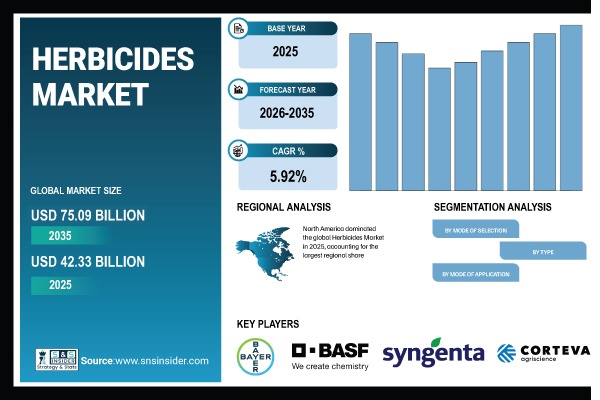
Austin, June 17, 2026 (GLOBE NEWSWIRE) -- According to SNS Insider, The Herbicides Market was valued at USD 42.33 Billion in 2025 and is expected to reach USD 75.09 Billion by 2035, growing at a CAGR of 5.92% over 2026–2035.
The Herbicides Market is growing at a steady pace, driven by rising global demand for food, farm mechanisation and increasing populations of herbicide-resistant weeds, all of which are driving above-average investment in weed management solutions. Herbicides are still crucial in cereals, oilseeds, fruit and vegetables where weed competition for light, water and nutrients causes yield losses that can be controlled more cost-effectively by chemical means than by any other method. One good example is the agreement between FMC Corporation and Bayer to commercialise Isoflex herbicide across 30 million hectares of European winter cereals in May 2025, combining novel mode-of-action formulations with Bayer ’s registration and distribution network to tackle blackgrass and ryegrass resistance. This is the kind of premium innovation investment that resistant weed management is spurring around the world.
Get a Sample Report of Herbicides Market Growth Strategy @ https://www.snsinsider.com/sample-request/5726
Segmentation Analysis:
By Mode of Selection, Selective Herbicides Dominated the Market; Non-Selective Herbicides Segment to Grow with the Fastest CAGR Globally
Selective Herbicides Dominated in 2025 with Revenue Share of ~65.3% This is attributed to their efficacy in controlling the weeds while ensuring the health of the crops such as cereals, oilseeds and row crops. The combination of efficacy and crop safety continues to drive the global agricultural sector’s preference for selective herbicides. Post-emergence flexibility in a variety of crop systems helps secure their commercial dominance. The Non-Selective Herbicides segment is the fastest growing, due to rising use in no-tillage agriculture, burndown applications before planting, industrial vegetation management and herbicide-tolerant crop systems. These offer broad-spectrum activity against grasses, broadleaves and sedges, driving increased procurement as conservation agriculture grows worldwide.
By Crop Type, Cereals & Grains Dominated the Market; Fruits & Vegetables Segment to Witness Fastest CAGR Growth Globally
Cereals & Grains led with about 41.8% of revenue share in 2025, owing to the dominant share of global agricultural acreage for growing wheat, corn, rice, barley, and sorghum, and the recurring demand for herbicides these staple crops generate. Herbicide resistance is increasing in cereal production, which is creating a need for improved weed management practices to preserve the use of herbicide in this segment. Fruits & Vegetables is the fastest growing crop type, supported by increases in fresh fruit and vegetable consumption worldwide, changes in dietary habits towards healthier food and the export-oriented production of fruits & vegetables, which require effective weed management to ensure commercial success due to quality and appearance criteria.
Regional Insights:
In 2025, North America dominated the global Herbicides Market. The United States was the primary driver of the region’s revenues, accounting for nearly 82.5% of the regional revenues, with the world’s most intensive GM crop herbicide system. The structural change in resistant weed management is driving demand for premium herbicide products as declining glyphosate performance drives use of supplemental modes of action. Canada’s presence in canola, wheat and pulse crop herbicide markets is marked by specific procurement needs based on pre-harvest desiccation requirements.
- The U.S. Herbicides Market is projected to grow from USD 10.73 billion in 2025 to USD 19.01 billion by 2035, at a CAGR of 5.89% The increase is due to the widespread use of glyphosate-tolerant crops and the increasing incidence of weeds resistant to herbicide, thus boosting demand for other chemicals including dicamba, 2,4-D and HPPD inhibitors.
Europe Herbicides Market has a considerable share in the global market and is led by France, Germany, Ukraine, UK, and Spain. The massive production of cereals, oilseeds and sugar beetroots creates a demand for technically advanced herbicides. Germany makes up about 28.5% of European revenues, driven by large crop acreage and the commercial presence of BASF and Bayer . Simultaneously, the EU's Farm to Fork pesticide reduction targets and progressive active ingredient re-evaluations are limiting generic product availability while creating premium opportunities for novel modes of action and bio-herbicide alternatives that meet the tightened regulatory standards.
- The Europe Herbicides Market is anticipated to reach USD 17.34 Billion by 2035, expanding at a compound annual growth rate of 5.47% between the years 2026 and 2035. In 2025, the market is forecast to be worth USD 10.18 Billion.
Asia Pacific is the fastest-growing regional market, driven by rice, wheat, and soybean production intensification across China, India, Vietnam, and Indonesia where mechanized cultivation is creating herbicide adoption at rates traditional practices never required. China accounts for approximately 38.5% of regional revenues as both the largest herbicide manufacturing country and a major consumption market, while India is growing fastest through government food security programmes promoting weed management technology adoption.
For a Personalized Briefing with Our Industry Analysts, Connect Group Now @ https://www.snsinsider.com/request-analyst/5726
Growing Food Demand and Precision Spray Innovation to Augment Market Expansion Globally
Growing global food demand and the issue of herbicide resistant weeds are requiring intensive weed management and are prompting investment in new chemistry, both of which will continue to propel the herbicide market growth in the upcoming years. Artificial intelligence, machine vision and real-time weed detection in precision spot-spray technologies offer opportunities for substantial reduction in application rates while maintaining weed suppression efficacy, resulting in improved cost-effectiveness and sustainability outcomes. The rise of organic farming, regulation of synthetic herbicides and the need for resistance management are driving bio-herbicide innovation and forming an expanding alternative weed control commercial category, which will sustain market diversification and premium product revenue through 2035.
Major Players Analysis Listed in the Herbicides Market Report:
- Bayer AG
- BASF SE
- Syngenta AG (ChemChina)
- Corteva Agriscience
- FMC Corporation
- UPL Ltd.
- Adama Agricultural Solutions Ltd. (ChemChina)
- Nufarm Ltd.
- Sumitomo Chemical Co. Ltd.
- Arysta LifeScience (UPL)
- Nichino America Inc.
- American Vanguard Corporation
- Albaugh LLC
- Sipcam Oxon SpA
- Sapec Agro SA
- Helena Chemical Company
- Drexel Chemical Company
- Wilbur-Ellis Holdings Inc.
- Wynca Group (Hangzhou Wynca Chemical)
- Rainbow Chemical Co. Ltd.
Recent Developments:
- 2025: FMC Corporation and Bayer partnered to commercialize Isoflex herbicide across 30 million hectares of European winter cereals, addressing blackgrass and ryegrass resistance management with a novel mode of action formulation.
- 2025: Syngenta acquired Novartis 's natural compounds repository and established a biologicals production facility in South Carolina, advancing biological herbicide alternatives for the Americas market.
Purchase Single User PDF of Herbicides Market Report @ https://www.snsinsider.com/checkout/5726
Exclusive Sections of the Report (The USPs):
- HERBICIDE DEPLOYMENT & WEED MANAGEMENT PERFORMANCE METRICS – helps you understand usage trends across selective and non-selective herbicide categories along with improvements in weed suppression efficacy, crop yield protection, and resistance management outcomes.
- HERBICIDE RESISTANCE & NOVEL MODE OF Action METRICS – helps you evaluate adoption trends in alternative herbicide chemistry, mode of action rotation programmes, and premium resistance management product penetration across major crop systems globally.
- PRECISION APPLICATION & DIGITAL AGRICULTURE METRICS – helps you analyze AI-powered spot-spray technology adoption, herbicide use reduction outcomes, and precision weed detection system integration across commercial farm operations.
- BIO-HERBICIDE & SUSTAINABLE WEED CONTROL METRICS – helps you uncover growth in microbial and plant-based herbicide development, organic farming weed management adoption, and biological alternative commercialization across regulated markets.
- CROP-SPECIFIC HERBICIDE DEMAND METRICS – helps you identify growth opportunities across cereal, oilseed, fruit, and vegetable herbicide programmes along with GM crop system herbicide procurement trends and export quality compliance-driven adoption.
- COMPETITIVE LANDSCAPE & HERBICIDES EXPANSION METRICS – helps you gauge the competitive strength of key market players based on novel active ingredient development, biological portfolio investment, resistance management programme development, and regional registration capability globally.
Herbicides Market Report Scope
| Report Attributes | Details |
| Market Size in 2025 | USD 42.33 Billion |
| Market Size by 2035 | USD 75.09 Billion |
| CAGR | CAGR of 5.92% From 2026 to 2035 |
| Base Year | 2025 |
| Forecast Period | 2026-2035 |
| Historical Data | 2022-2024 |
| Key Segments | • By Mode of Selection (Selective Herbicides, Non-Selective Herbicides) • By Type (Glyphosate, Atrazine, 2,4-D, Acetochlor, Glufosinate, Bio-herbicides, Others) • By Mode of Application (Foliar Spray, Soil Treatment, Seed Treatment, Others) • By Crop Type (Cereals & Grains, Oilseeds & Pulses, Fruits & Vegetables, Others) |
| Regional Analysis/Coverage | North America (US, Canada), Europe (Germany, UK, France, Italy, Spain, Russia, Poland, Rest of Europe), Asia Pacific (China, India, Japan, South Korea, Australia, ASEAN Countries, Rest of Asia Pacific), Middle East & Africa (UAE, Saudi Arabia, Qatar, South Africa, Rest of Middle East & Africa), Latin America (Brazil, Argentina, Mexico, Colombia, Rest of Latin America). |
Rising Demand for Herbicides Market Data, Our Full Report Trend Analysis @ https://www.snsinsider.com/reports/herbicides-market-5726
Other Related Report:
The Nitrogenous Fertilizer Market size was USD 63.55 Billion in 2023 and is expected to reach USD 105.36 Billion by 2032 and grow at a CAGR of 5.78% over the forecast period of 2024-2032.
The Phosphate Fertilizer Market was valued at USD 74.98 billion in 2025 and is expected to reach USD 132.9 billion by 2035, growing at a CAGR of 5.89% from 2026–2035.
The Potash Fertilizers Market was valued at USD 27.96 Billion in 2025 and is expected to reach USD 48.98 Billion by 2035, growing at a CAGR of 5.18% from 2026–2035.
The Biofertilizers Market size was valued at USD 3.01 Billion in 2024. It is expected to grow to USD 7.13 Billion by 2032 and grow at a CAGR of 11.40% over the forecast period of 2025-2032.
The Green Fertilizer Market Size was valued at USD 2.15 billion in 2023, and is expected to reach USD 3.53 billion by 2032, and grow at a CAGR of 5.65% over the forecast period 2024-2032.
About Us:
SNS Insider is one of the leading market research and consulting agencies that dominates the market research industry globally. Our company's aim is to give clients the knowledge they require in order to function in changing circumstances. In order to give you current, accurate market data, consumer insights, and opinions so that you can make decisions with confidence, we employ a variety of techniques, including surveys, video talks, and focus groups around the world.
CONTACT: Contact Data
Contact Us:
Rohan Jadhav - Principal Consultant
Phone: +1-315 636 4242 (US) | +44- 20 3290 5010 (UK)


| About us | Network | Partners |
| Fpgroup.nlinfo@analist.nlRSS feedContactIntellectual Property Photos |
Analist.nlLinksISIN
|
MorningstarPrudena.comAAII.comNASDAQvwd GroupEuronextBATS Chi-x |
