
$5.34 Bn Railway Testing Market by End Use, Superstructure Testing Equipment, Electrification Testing Equipment, Use Case, Application, and Region - Global Forecast to 2032
The railway testing market is anticipated to expand from USD 3.91 billion in 2025 to USD 5.34 billion by 2032 at a CAGR of 4.6%. This growth is driven by increased demand for advanced railway testing equipment to enhance operational efficiency, safety, and infrastructure longevity. Key market drivers include rising safety standards, the need for predictive maintenance, and minimizing service disruptions. The Asia Pacific market is projected to grow rapidly, fueled by national rail expansion programs and the integration of digital monitoring technologies. Leading players like Knorr-Bremse AG and Wabtec Corporation dominate the sector, fostering innovation and global scalability in railway testing solutions.
Dublin, March 03, 2026 (GLOBE NEWSWIRE) -- The "Railway Testing Market by End Use, Superstructure Testing Equipment, Electrification Testing Equipment, Use Case, Application, and Region - Global Forecast to 2032" report has been added to ResearchAndMarkets.com's offering.
The railway testing market is projected to grow from USD 3.91 billion in 2025 to USD 5.34 billion by 2032, at a CAGR of 4.6%
Railway testing equipment is becoming increasingly central to operational efficiency, safety assurance, and infrastructure longevity in the rail sector. Growing complexity in rolling stock, signaling systems, and track networks is driving demand for advanced measurement and diagnostic solutions. Additionally, data acquisition (DAQ) systems, on-board sensors, and portable testing devices are enabling precise monitoring of parameters, such as axle loads, track geometry, brake performance, and propulsion efficiency. 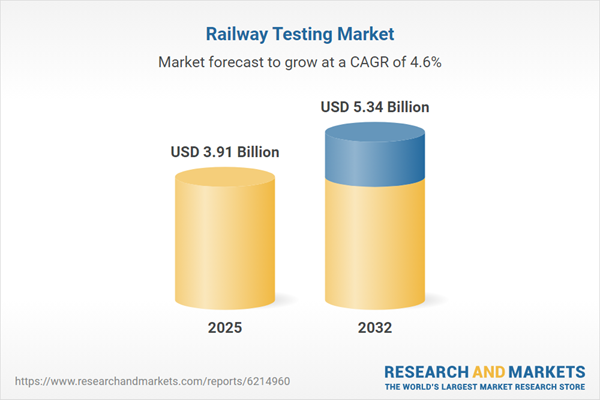
Some of the other key drivers of this market include rising safety and reliability standards, the need for predictive maintenance, and pressure to minimize service disruptions. Integration of real-time analytics with testing platforms is allowing operators to identify deviations early, optimize maintenance schedules, and improve lifecycle management of assets.
The railway testing market is witnessing a shift toward automated, high-precision, and modular testing solutions that support post delivery inspection and ongoing operational monitoring, positioning railway testing equipment as a critical enabler of modern rail system performance.
The railway testing market is dominated by a few globally established players, such as Knorr-Bremse AG (Germany), ZF Friedrichshafen AG (Germany), Wabtec Corporation (US), HORIBA Group (Japan), and RENK Group AG (Germany). These companies manufacture and supply railway testing equipment to various countries globally. These companies have set up R&D infrastructure and offer best-in-class solutions to their customers.
The railway power supply testing equipment is projected to be the fastest-growing market during the forecast period.
By electrification testing equipment, the railway power supply testing equipment is projected to be the fastest-growing segment during the forecast period, as railway operators are upgrading traction substations and overhead electrification systems to handle higher power demand from modern trains. These upgrades require tighter verification of power quality, load behaviour, and protection system responses.
Networks that are adding high-speed, metro, and heavy haul freight capacity are facing greater pressure to maintain stable voltage and rapid fault isolation, which is driving the use of advanced testing tools that can assess harmonics, transient behaviour, and substation control logic with higher accuracy. This shift is strategic because power supply performance directly affects acceleration capability, punctuality, and system safety. Thus, operators seek equipment that reduces commissioning time and supports predictive maintenance planning.
Agencies in India and Japan are validating new traction substation configurations on upgraded corridors using high-precision power analysers and simulation-based load testing units, which confirm performance under peak operational demand and ensure that electrical systems can support the expected service intensity.
The post-delivery & upkeep inspection segment is projected to be the fastest-growing segment during the forecast period.
By application, the post-delivery & upkeep inspection segment is projected to be the fastest-growing application segment during the forecast period, because operators are tightening their performance assurance processes as networks expand, train frequencies increase, and system upgrades become more complex. This shift in operating conditions is creating the need for continuous validation of new and in-service assets, since any deviation in track geometry, overhead line parameters, braking performance, or on-board control systems can disrupt service reliability and raise lifecycle costs.
As a result, operators are adopting structured inspection cycles supported by automated measurement cars, portable diagnostics, and digital monitoring platforms that provide consistent and repeatable data throughout the asset lifecycle. This is strengthening the role of upkeep inspections as a strategic function rather than a routine compliance activity.
Leading metro systems in Asia are applying dedicated post-delivery acceptance tests for new trainsets and conducting high-frequency upkeep inspections on recently upgraded traction, signalling, and electrification assets, using precise measurement tools that verify operational readiness before deployment and maintain performance standards across intensive daily schedules.
Asia Pacific is projected to be the fastest-growing market during the forecast period.
Asia Pacific is projected to be the fastest-growing market during the forecast period as national rail programs are expanding their capital expenditure on new corridors, suburban upgrades, and modern rolling stock, which is increasing the requirement for advanced measurement technologies that can manage high volumes of construction and maintenance activity.
Additionally, governments are accelerating timelines for high-speed and freight projects, and operators are introducing tighter reliability targets, which is pushing the shift toward automated track geometry systems, overhead line inspection platforms, and on-board diagnostic solutions. The region is also adopting digital condition monitoring tools that reduce manual inspection time and improve asset availability, especially on networks that are adding capacity at a rapid pace.
The Indian Railways has rolled out automated track geometry systems, overhead line monitoring units, and real-time measurement platforms across dedicated freight corridors and semi-high-speed routes. This development is creating consistent demand for suppliers that can support broad network scale testing and monitoring requirements.
Key Benefits of Buying the Report
- This report will help market leaders/new entrants in this market with information on the closest approximations of revenue numbers for the overall railway testing ecosystem and its subsegments.
- This report will help stakeholders understand the competitive landscape and gain more insights to position their businesses better and plan suitable go-to-market strategies.
- This report will also help stakeholders understand the market's pulse and provide information on key market drivers, restraints, challenges, and opportunities.
Key Attributes:
| Report Attribute | Details |
| No. of Pages | 281 |
| Forecast Period | 2025 - 2032 |
| Estimated Market Value (USD) in 2025 | $3.91 Billion |
| Forecasted Market Value (USD) by 2032 | $5.34 Billion |
| Compound Annual Growth Rate | 4.6% |
| Regions Covered | Global |
Market Dynamics
Drivers
- Global Focus on Rail Modernization
- Need for Improved Rail Safety and Reliability Standards
- Expansion of High-Speed Urban Metro Projects
- Growing Demand from Heavy-Haul and Freight Corridor Development
Restraints
- Fragmented Rail Infrastructure and Lack of Standardization
- High Cost of Railway Testing Equipment
Opportunities
- Emerging Markets in Railway Infrastructure
- Integration of Digital Technologies
Challenges
- Complex Stakeholder Ecosystem
Unmet Needs and White Spaces
- Limited Integration Across Multi-Modal and Cross-Platform Data Systems
- Inadequate Low-Cost and Modular Testing Solutions for Secondary Rail Lines
- Limited Testing Infrastructure for New Materials and Hybrid Track Systems
Interconnected Markets and Cross-Sector Opportunities
Strategic Moves by Key Players in Railway Testing Market
Industry Trends
Ecosystem Analysis
- Raw Material & Component Suppliers
- Railway Equipment Manufacturers
- Technology Providers
- Infrastructure Providers
- Maintenance & Service Providers
- Regulatory & Policy Makers
- Railway Operators
Value Chain Analysis
- Raw Material Providers and Component Suppliers
- Original Equipment Manufacturers
- Operators and End-users
Case Study Analysis
- Network Rail Deployed New Measurement Train Equipped with Laser Geometry Systems, Inertial Sensors, and High-Speed Imaging
- Sbb Introduced Ultrasonic Testing Vehicles That Scanned Rails for Internal Fatigue Cracks
- Mtr Deployed Ground-Penetrating Radar on Inspection Vehicles to Map Ballast and Subgrade Condition
Company Profiles
- Knorr-Bremse AG
- Zf Friedrichshafen AG
- Wabtec Corporation
- Horiba Group
- Renk Group AG.
- Spectris
- Wago
- Ador Tech Inc.
- Ametek Inc.
- Keysight Technologies
- National Instruments Corp .
- Akebono Brake Industry Co. Ltd.
- Mts Systems
- Hexagon Ab
- Trimble Inc .
- Intertek PLC
- Tuv Sud
- Avl
- Dspace
- Ricardo
- Rohde & Schwarz
- Illinois Tool Works .
- Robert Bosch GmbH
- Mb Dynamics, Inc.
- Pandrol
- Kingsine Electric Automation Co. Ltd.
For more information about this report visit https://www.researchandmarkets.com/r/qlexwq
About ResearchAndMarkets.com
ResearchAndMarkets.com is the world's leading source for international market research reports and market data. We provide you with the latest data on international and regional markets, key industries, the top companies, new products and the latest trends.
Attachment
CONTACT:
CONTACT: ResearchAndMarkets.com
         Laura Wood, Senior  Press Manager
         press@researchandmarkets.com
         For E.S.T Office Hours Call 1-917-300-0470
         For U.S./ CAN Toll Free Call 1-800-526-8630
         For GMT Office Hours Call +353-1-416-8900


| About us | Network | Partners |
| Fpgroup.nlinfo@analist.nlRSS feedContactIntellectual Property Photos |
Analist.nlLinksISIN
|
MorningstarPrudena.comAAII.comNASDAQvwd GroupEuronextBATS Chi-x |
