
Polymers Market Size to Reach USD 1,424.98 Billion by 2035 - Exclusive Report by Towards Chemical and Materials
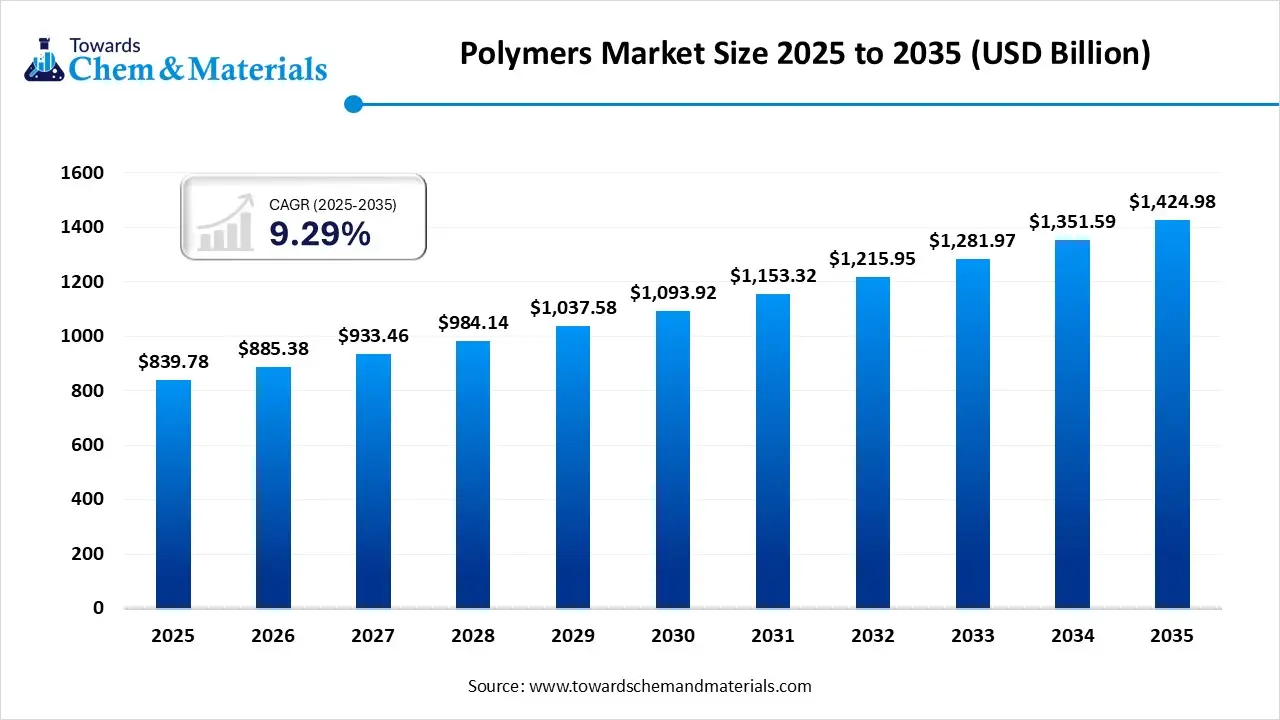
The global polymers market size is estimated at USD 885.38 billion in 2026 and is expected to be worth around USD 1,424.98 billion by 2035, exhibiting a compound annual growth rate (CAGR) of 5.43 % over the forecast period from 2026 to 2035. A study published by Towards Chemical and Materials a sister firm of Precedence Research.
Ottawa, Feb. 23, 2026 (GLOBE NEWSWIRE) -- According to Towards Chemical and Materials, the global polymers market size was valued at USD 839.78 billion in 2025 and is expected to hit around USD 1,424.98 billion by 2035, exhibiting at a compound annual growth rate (CAGR) of 5.43 % over the forecast period from 2026 to 2035. Asia Pacific dominated the Polymers market with the largest revenue share of 47.25% in 2025. The growth is driven by circular economy initiatives, technological advancement, stringent regulations, and increasing industrial demand.
Download a Sample Report Here@ https://www.towardschemandmaterials.com/download-sample/5776
What are Polymers?
Polymers are well-defined as materials ranging from commodity plastics to high-performance resins, serving as high-utility solutions that promote modern industries and consumer supply chains. It offers durability, strength, chemical resistance, thermal stability, and chemical inertness, allowing substitution for less efficient materials. Additionally, the market focuses on developing smart, biodegradable, and high-performance plastics supporting sustainable manufacturing.
Request Research Report Built Around Your Goals: sales@towardschemandmaterials.com
Polymers Market Report Highlights
- The Asia-Pacific dominated the polymers market with the largest revenue share of 47.25% in 2025.
- By type, the polyethylene segment dominated the market and accounted for the largest revenue share of 26.84% in 2025.
- By origin, the synthetic polymers application segment led the market with the largest revenue share of 92.10% in 2025.
- By processing technology, the injection molding segment dominated the market and accounted for the largest revenue share of 37.00% in 2025.
- By end-use industry, the FMCG segment led the market with the largest revenue share of 36.66% in 2025.
Immediate Delivery Available | Buy This Premium Research Report (Global Deep Dive
USD 3200) @ https://www.towardschemandmaterials.com/checkout/5776
Why are polymers and plastics important?
Naturally-occurring polymers include proteins and DNA, the building blocks of life on Earth. Other natural polymers, such as wool, have played a significant role in human societies for centuries.
More recently, synthetic polymers have become an integral part of the global economy, valued for their immense versatility and low production costs. For example, between 1950 and 2015, 8.3 billion tons of plastic were produced – equivalent to more than 1,000 kilos per head of the world’s present population – of which 50% was manufactured after 2004.
What are the challenges associated with polymers and plastics?
Synthetic polymers present a significant environmental challenge for two main reasons. The first is that their current production is mostly reliant on petrochemical products, the use of which contributes to rising global temperatures. The second challenge is disposal. Due to their slow biodegradability, synthetic polymers (mostly plastics) often cause environmental deterioration after disposal, which can harm ecosystems and threaten the global food chain. Solving this twofold issue depends on finding more responsible ways of producing and disposing of synthetic polymers.
For more information, visit the Towards Chemical and Materials website or email the team at sales@towardschemandmaterials.com| +1 804 441 9344
Private Industry Investments for Polymers:
- BASF SE (Ludwigshafen Verbund Site): The company is committing between €1.5 billion and €2 billion annually through 2028 to fund its primary manufacturing and research site, emphasizing engineering plastics and polyurethanes.
- Evonik Industries AG (Shanghai Expansion): Evonik has doubled its production capacity in Shanghai for long-chain polyamides to address the rapidly growing demand from the Asian automotive and electric vehicle sectors.
- ADNOC and OMV (Polyolefin Merger): These entities merged their polyolefin businesses (Borouge and Borealis) in early 2025 to create a USD 20 billion petrochemical giant focused on global plastic raw material supply.
- Reliance Industries (India Infrastructure): As India's largest private producer of plastic raw materials, Reliance continues to lead major private sector commitments, part of a broader $45 billion investment alongside other players, to expand domestic petrochemical capacity.
- EF Polymer (Series B Funding): This startup secured Series B equity funding in late 2025 from investors like Toyoda Gosei to further develop sustainable and eco-friendly polymer solutions.
What Are Major Trends in the Polymers Market?
- Rising Focus on Bio-Polymers: Innovations in polymer chemistry enhance mechanical strength and thermal stability. Innovation in novel biopolymers and scaling of high-performance polymers. Innovation also focused on utilising non-food biomass sources.
- Advanced Recycling Integration: Enzymatic recycling and chemical depolymerization allow polymers to be broken down into original monomers and reused, driving the sustainable growth.
Polymers Market Dynamics
Driver
Sustainability and Eco-Friendly Solutions
The increasing focus on reducing environmental impact and strict regulations is driving the adoption of green chemistry principles, bio-based and biodegradable polymers, and low-toxicity products. Forcing manufacturers to invest in R&D to ensure sustainable materials and recycled polymer technologies with safety and environmental standards.
Restraints
Raw Material Price Volatility
The raw materials, such as crude oil-derived monomers like propylene and benzene, are facing fluctuation in prices that affect the manufacturing cost and make it difficult for producers to price polymers competitively, limiting the adoption and overall market expansion.
Opportunity
Government Initiatives and Collaboration
The massive opportunity driven by government support in advanced polymer recycling technologies to increase recycling rates. The manufacturers invest in energy-efficient lightweight materials and circular economy adoption. The collaboration between producers, recyclers, consumer brands, and waste management companies is enabling market long-term growth.
Technological Advancement in the Polymers Industry
AI and macromolecular science are transforming the polymers industry from traditional chemistry to predictive material intelligence by enabling the generation of smart polymers. Machine learning and molecular simulations predict material properties before synthesis, reducing research time. Autonomous labs and AI- driven recycling improve purity, adjust polymerization consistency and energy efficiency, creating precise, high-performance materials appropriate for a digital and sustainable future.
Immediate Delivery Available | Buy This Premium Research Report@ https://www.towardschemandmaterials.com/checkout/5776
Polymers Market Segmentation Insights
Type Insights
How Does the Polyethylene Segment Dominate the Polymers Market?
The polyethylene leads the market due to its molecular adaptability and economic efficiency. Its chemical resilience, hydrophobic nature, moisture- proof qualities, and high- speed manufacturing compatibility. It is essential for corrosion-resistant, lightweight, durable components that reduce logistical costs and energy use. Overall, polyethylene is central to the global supply chain and modern manufacturing infrastructure.
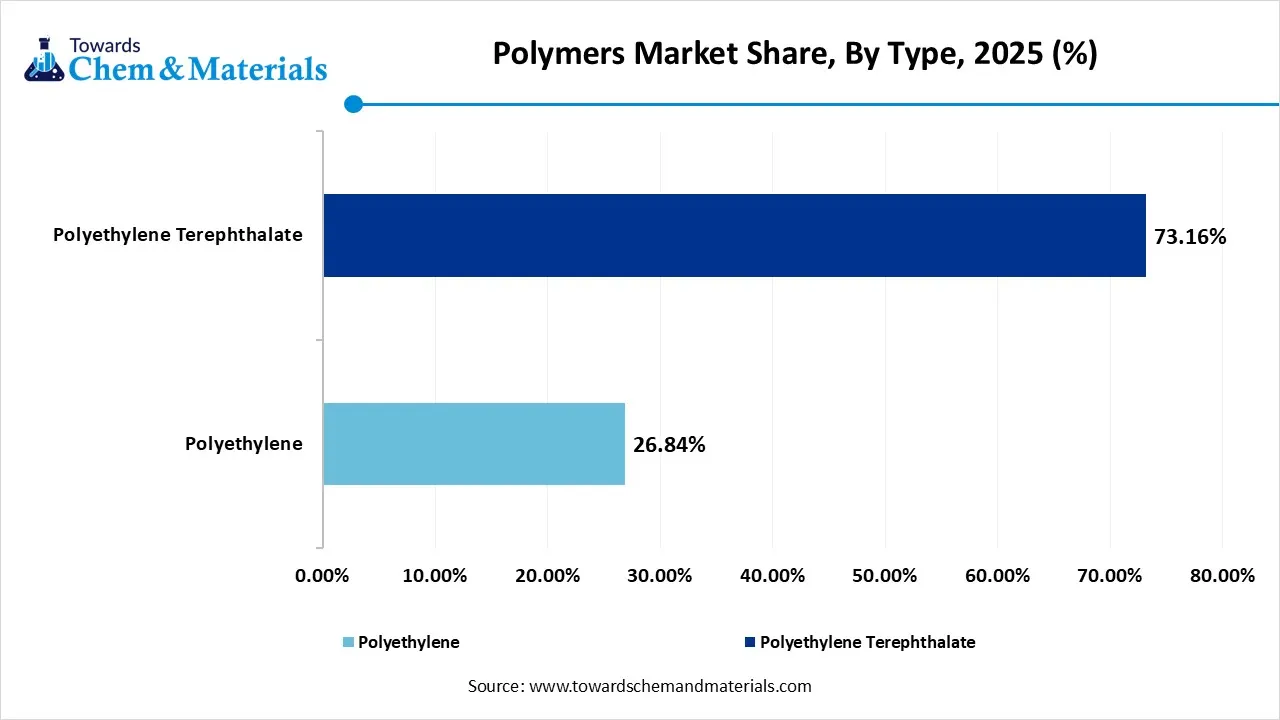
The polyethylene terephthalate (PET) segment shows significant growth during the forecast period, for food packaging to prevent contamination and textiles because of its longevity. Its chemical resistance, tensile strength, and gas barrier properties to block oxygen and carbon dioxide drive its expansion. The PET offers lightweight, shatter-resistant, and recyclable properties for high-quality secondary production support the circular economy and environmental responsibility.
Polymers Market Share, By Type, 2025 (%)
| By Type | Revenue Share, 2025 (%) | |
| Polyethylene | 26.84 | % |
| Polyethylene Terephthalate | 73.16 | % |
Origin Type Insights
Which Origin Type Segment Dominates the Polymers Market?
Synthetic polymers dominate the market through precise molecular synthesis, high- volume scalability, and durability. They can be engineered for high- temperature stability, chemical inertness, and toughness, essential for industries like medical devices, electronics and aerospace. Their integration into automated manufacturing processes reduces costs while maintaining precision, serving as key materials for the modern economy and global infrastructure.
Polymers Market Share, By Origin, 2025 (%)
| By Origin | Revenue Share, 2025 (%) | |
| Synthetic Polymers | 92.10 | % |
| Natural Polymers | 7.90 | % |
The natural polymers segment offers significant growth during the projected period. The natural polymers derived from renewable sources like cellulose, protein, and starch offer biocompatibility, non- toxicity, and sustainability. They are crucial in pharmaceuticals, food coatings, and regenerative medicine due to their versatility and non-toxic nature. Additionally, rising focus on the reduction of plastic waste and the circular economy, bridging its industrial use with ecological responsibility.
Processing Technology Insights
How did Injection Molding Segment Dominate the Polymers Market?
The injection molding segment maintains its dominance in the market by enabling automated, precise production of intricate components by transforming modern resins with zero post- processing. The technology is essential for industries such as aerospace, medical, consumer electronics, and automotive to ensure consistency and low costs. Its ability to integrate additives and structural reinforcements in a single process offers lightweighting and complexity, that maintain its leadership in modern polymer fabrication.
Polymers Market Share, By Processing Technology, 2025 (%)
| By Processing Technology | Revenue Share, 2025 (%) | |
| Injection Moulding | 37.00 | % |
| Blow Molding | 63.00 | % |
| Extrusion | 5.00 | % |
| Compression Molding | 2.50 | % |
| Rotational Molding | 3.00 | % |
| Others (Thermoforming, Calendering, etc.) | 2.50 | % |
The blow molding segment is set to experience the fastest growth, characterized by its high-speed fabrication of lightweight and hollow parts efficiently due to its capability to develop molten polymer with an ideal strength ratio. It's essential for beverage and chemical containers, offering durability, purity, safety, and design flexibility. Its lower tooling costs make it ideal for large-scale production in medical and automotive, ensuring structural integrity.
End-Use Industry Insights
Why did the FMCG Segment hold the biggest share in the Polymers Market?
The fast-moving consumer goods segment dominated the market, fueled by demand for versatile packaging that enables product safety. Polymers offer lightweight, durable, and cost-effective solutions for food, beverages, personal care, and household items. With the rise of convenience and e- commerce, reliance on advanced polymer films and containers grows. This segment leads in plastic resin consumption and innovation, pushing high- performance barrier technology and sustainable solutions that balance market distribution and environmental care.
Polymers Market Share, By End-use, 2025 (%)
| By End Use | Revenue Share, 2025 (%) | |
| FMCG | 36.66 | % |
| Automotive OEMs | 63.34 | % |
| Construction Firms | 5.00 | % |
| Electronics Manufacturers | 4.00 | % |
| Medical Device Manufacturers | 3.00 | % |
| Textile Manufacturers | 2.50 | % |
| Agricultural Input Producers | 2.50 | % |
| Industrial Equipment Manufacturers | 2.50 | % |
The medical device manufacturers segment is experiencing the fastest growth in the market during the projected period. Due to its demand for high-performance, medical-grade resins for biocompatibility and structural strength. Its growth has shifted from surgical tools to implants by offering lightweight, shatterproof, chemically resistant devices, advancing personalised medicine and diagnostics. Overall, this sector maintains high standards of purity and performance by focusing on polymer science at the forefront of medical technology.
Regional Insights
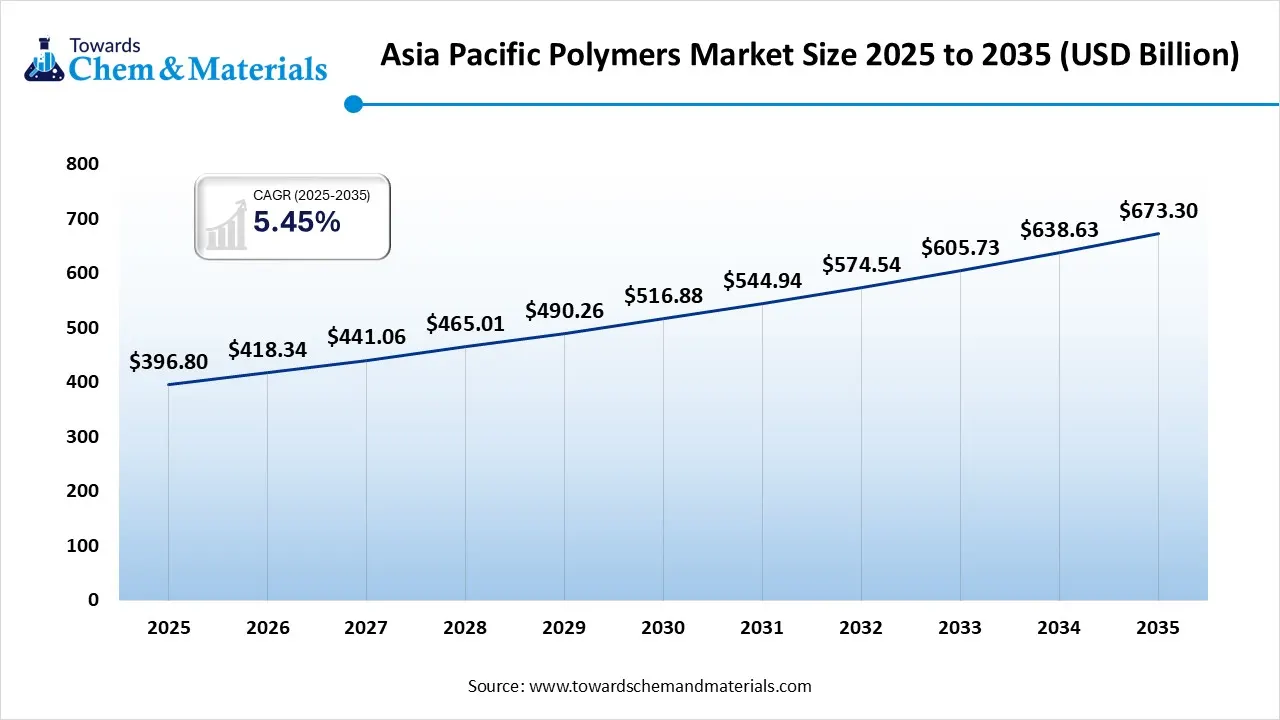
Asia Pacific polymers market size was valued at USD 396.80 billion in 2025 and is expected to be worth around USD 673.30 billion by 2035, exhibiting at a compound annual growth rate (CAGR) of 5.45% over the forecast period from 2026 to 2035.
How did Asia Pacific Dominate the Polymers Market?
Asia Pacific dominated the market, driven by industrialization & urbanization and a digital economy, which boosts demand for advanced packaging, electronics, and lightweight automotive parts. The region is leading in sustainable practices by investing in circular supply chains and biopolymers, shaping the future of polymers with industrial scale and material innovation.
China Polymers Market Trends
China’s market is experiencing strong growth driven by rising demand in key industries such as packaging, automotive, construction, and electronics, with the overall market projected to expand significantly through 2031. Polymers are increasingly used in lightweight materials and advanced applications, helping improve energy efficiency and driving higher consumption.
Polymers Market Share, By Region, 2025(%)
| By Region | Revenue Share, 2025 (%) | |
| North America | 21.00 | % |
| Europe | 15.75 | % |
| Asia Pacific | 47.25 | % |
| Latin America | 10.30 | % |
| Middle East & Africa | 10.70 | % |
Why is Europe the Fastest-Growing Region in the Polymers Industry?
Europe is expected to grow fastest during the forecast period, driven by a focus on the circular economy, emphasising high-value innovation. Its market focuses on mechanical and chemical recycling to meet climate-neutrality goals, driven by strict regulations and advanced manufacturing needs for electric mobility and precision engineering. Europe's goals in bio- based and waste- derived resins set a global standard for sustainable industrial growth.
Germany Polymers Market Trends
Germany’s market is expanding as demand grows from key end-use industries such as automotive, construction, packaging, and electrical/electronics. Sustainability and circular economy initiatives are driving increased use of recyclable, biodegradable, and bio-based polymers, as well as investment in advanced recycling technologies.
More Insights in Towards Chemical and Materials:
- Organosilicon Polymers Market Size to Hit USD 29.88 Bn by 2035
- Conductive Polymers Market Size to Surpass USD 14.81 Bn by 2035
- Ion-Conductive Polymers Market Size to Hit USD 8.75 Bn by 2035
- Smart Textile Polymers Market Size to Hit USD 9.63 Million by 2035
- Biopolymers Market Size to Reach USD 53.68 Billion by 2034
- Liquid Crystal Polymers Market Size to Hit USD 6.73 Billion by 2034
- Bio-Based Polymers Market Size to Hit USD 58.36 Billion by 2034
- Medical Fluoropolymers Market Volume to Reach 13.87 Kilo Tons by 2034
- Lignin-based Biopolymers Market Size to Hit USD 2.07 Bn by 2034
- Fluoropolymers Market Volume to Reach 1351.23 Kilo Tons 2034
- Water Treatment Polymers Market Volume to Hit 15,477.50 Kilotons by 2034
- Bioresorbable Polymers Market Volume Reach 3,839.1 kilotons by 2034
- Europe Biopolymers Market Size to Surge USD 18.23 Billion by 2035
- Europe Biopolymers Market Size to Surge USD 18.23 Billion by 2035
- U.S. Biopolymers Market Size to Worth Around USD 22.16 Bn by 2035
- Europe Bioplastics and Biopolymers Market Size to Reach USD 34.37 Bn by 2035
- U.S. Bioplastics and Biopolymers Market Size to Surpass USD 34.37 Bn by 2035
- Asia Pacific Biopolymers Market Size to Worth USD 26.39 Bn by 2035
- Europe Specialty Polymers Market Size to Surpass USD 72.19 Bn by 2035
- Asia Pacific Specialty Polymers Market Size to Surpass USD 70.70 Bn by 2034
- U.S. Specialty Polymers Market Size to Surpass USD 59.52 Bn by 2034
- Asia Pacific Polymers Market Size to Surge USD 598.92 Billion by 2034
Top Market Players in the Polymers Market & Their Offerings:
Dow Inc . – Supplies polyethylene, elastomers, and ethylene copolymers for high-performance packaging and infrastructure.
Evonik Industries AG – Specializes in high-performance polyamides and PEEK for the automotive, medical, and aerospace sectors.
Eastman Chemical Company – Manufactures specialty copolyesters and cellulosic plastics valued for their clarity and chemical resistance.
Covestro AG – Produces high-tech polycarbonates and polyurethane raw materials used in electronics and mobility solutions.
Mitsui Chemicals Inc. – Provides functional polymers and polypropylene compounds specifically tailored for automotive and industrial use.
Exxon Mobil Corporation – Operates as a global leader in producing polyethylene and polypropylene for consumer goods and packaging.
BASF SE – Offers an extensive range of engineering plastics and styrenic foams for technical industrial applications.
Clariant International Limited – Delivers specialty additives and masterbatches that enhance the color and durability of polymer products.
Huntsman Corporation – Focuses on MDI-based polyurethanes for energy-saving insulation and lightweight automotive components.
DSM-Firmenich – Supplies high-performance engineering plastics and bio-based resins for the electrical and electronics industries.
Polymers Market Top Key Companies:
- Dow Inc .
- Evonik Industries AG
- Eastman Chemical Company
- Covestro AG
- Mitsui Chemicals Inc.
- Exxon Mobil Corporation
- DSM-Firmenich
- BASF SE
- Clariant International Limited
- Huntsman Corporation
Recent Developments
- In February 2025, Tetra Pak introduced recycled polymer packaging. Moreover, the newly launched packaging material is certified by ISCC PLUS, as per the report published by the company recently
- In January 2025, SCHOTT Pharma launched its line of syringe systems. The newly launched syringe system is called the next-gen polymer syringe system, as per the company's claim.
- In October 2025, BASF and International Flavors & Fragrances (IFF) announced a strategic bioscience collaboration to accelerate the development of the designed Enzymatic Biomaterials platforms. This collaboration focuses on innovation in next generation enzyme and sustainable polymers in industrial applications.
Polymers Market Report Segmentation
This report forecasts revenue growth at global, regional, and country levels and provides an analysis of the latest industry trends in each of the sub-segments from 2019 to 2035. For this study, Towards Chemical and Materials has segmented the global Powder Coatings Market
By Type
- Thermoplastics
- Polyethylene (PE)
- Polypropylene (PP)
- Polyvinyl Chloride (PVC)
- Polystyrene (PS)
- Polyethylene Terephthalate (PET)
- Polycarbonate (PC)
- Acrylonitrile Butadiene Styrene (ABS)
- Polyamide (PA)
- Polymethyl Methacrylate (PMMA)
- Others (EVA, POM, etc.)
- Thermosetting Polymers
- Epoxy Resins
- Phenolic Resins
- Polyurethane (PU)
- Unsaturated Polyester Resins (UPR)
- Melamine Formaldehyde (MF)
- Urea Formaldehyde (UF)
- Elastomers
- Natural Rubber (NR)
- Synthetic Rubber (SBR, NBR, EPDM, etc.)
- Thermoplastic Elastomers (TPE)
By Origin
- Synthetic Polymers
- Natural Polymers (Cellulose, Starch, Proteins, etc.)
By Processing Technology
- Injection Molding
- Extrusion
- Blow Molding
- Compression Molding
- Rotational Molding
- Others (Thermoforming, Calendering, etc.)
By End-Use Industry
- FMCG
- Automotive OEMs
- Construction Firms
- Electronics Manufacturers
- Medical Device Manufacturers
- Textile Manufacturers
- Agricultural Input Producers
- Industrial Equipment Manufacturers
By Regional
- North America
- Europe
- Asia Pacific
- Latin America
- Middle East & Africa
Immediate Delivery Available | Buy This Premium Research Report@ https://www.towardschemandmaterials.com/checkout/5776
About Us
Towards Chemical and Materials is a leading global consulting firm specializing in providing comprehensive and strategic research solutions across the chemical and materials industries. With a highly skilled and experienced consultant team, we offer a wide range of services designed to empower businesses with valuable insights and actionable recommendations.
Our Trusted Data Partners
Towards chem and Material | Precedence Research | Statifacts | Towards Packaging | Towards Healthcare | Towards Food and Beverages | Towards Automotive | | Nova One Advisor | Nutraceuticals Func Foods | Onco Quant | Sustainability Quant | Specialty Chemicals Analytics | TCM Blog
For Latest Update Follow Us: https://www.linkedin.com/company/towards-chem-and-materials/
USA: +1 804 441 9344
APAC: +61 485 981 310 or +91 87933 22019
Europe: +44 7383 092 044
Email: sales@towardschemandmaterials.com
Web: https://www.towardschemandmaterials.com/


| About us | Network | Partners |
| Fpgroup.nlinfo@analist.nlRSS feedContactIntellectual Property Photos |
Analist.nlLinksISIN
|
MorningstarPrudena.comAAII.comNASDAQvwd GroupEuronextBATS Chi-x |
