
Hume Band 2026 Consumer Report: What Hume Health Discloses About "Metabolic Momentum," Biological Age Metrics, and Longevity Tracking
An informational overview examining category context, publicly available product disclosures, and what consumers often consider when researching wearable health monitoring device options in 2026 — including what Hume Health describes as Metabolic Momentum, biological age estimation, and longevity-oriented data tracking
WILMINGTON, DE, Feb. 19, 2026 (GLOBE NEWSWIRE) -- Disclaimer: This article is for informational purposes only. It is not medical advice. Health and wellness concerns should be evaluated by a qualified healthcare professional. This content does not diagnose, treat, cure, or prevent any disease. If you purchase through links in this article, a commission may be earned at no additional cost to you.
This release is an informational overview of publicly available disclosures for the Hume Band and broader consumer research behavior within the wearable health monitoring device category. The Hume Band is a consumer wellness device. It is not intended to diagnose, treat, cure, or prevent any disease. Nothing in this content should be interpreted as medical advice, a product endorsement, or a performance claim.
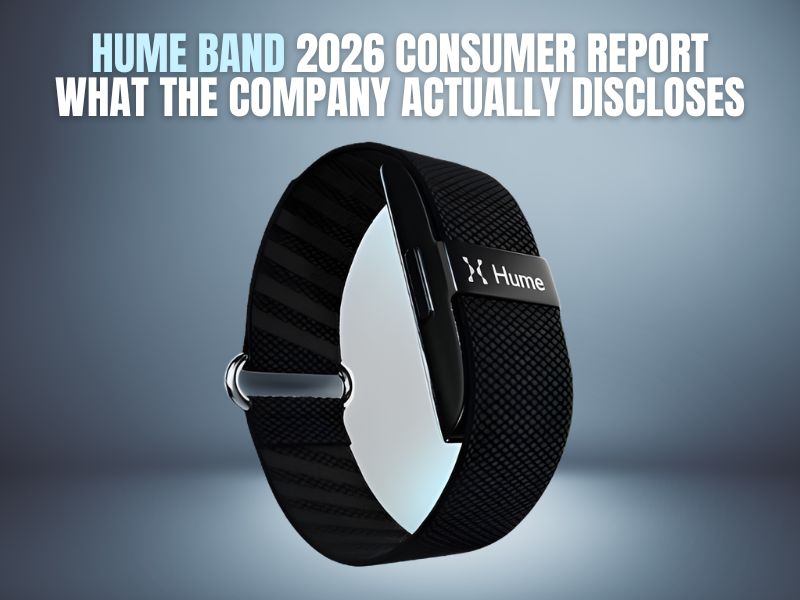
As consumer interest in wearable health monitoring devices — and specifically in longevity-focused metrics like biological age estimation, Metabolic Momentum, and HRV-related longevity-oriented trend tracking — continues to grow heading into 2026, updated product disclosures for the Hume Band have recently become publicly available. This article summarizes what Hume Health has disclosed about its product and provides category context for consumers who are actively researching their options.
Readers seeking primary-source detail can view the current Hume Band offer (official Hume Health page) to review the company's complete product disclosures directly. This article does not assess product effectiveness or outcomes and focuses solely on publicly available disclosures.
Why Consumer Research in This Category Has Grown in 2026
Consumer interest in wearable health monitoring devices that go beyond basic fitness tracking has grown considerably heading into 2026. Across public forums, social platforms, and broader online discussion, terms like Hume Band biological age, Metabolic Momentum explained, and wearable longevity tracking commonly appear in consumer research discussions — reflecting a consumer base that is asking more sophisticated questions than simple step counts or calorie totals.
That shift reflects something real about what people want from wearable technology right now. Heart rate variability, blood oxygen saturation, skin temperature, sleep stage analysis — none of these are niche interests anymore. They're mainstream research topics for people who want to understand not just how active they are, but what their body's data patterns might suggest about their health trajectory over time. Some companies have responded by publishing disclosures around proprietary metrics they describe as longevity-oriented, a framing that generates considerable consumer attention alongside appropriate scientific and regulatory scrutiny.
Understanding what a specific product actually discloses about its technology, methodology, and limitations — as distinct from what its marketing language implies — is a reasonable and necessary starting point for anyone doing serious research before making a purchase. That is what this article is designed to provide.
What Wearable Health Monitoring Devices Typically Involve
Wearable health monitoring devices in the direct-to-consumer space are electronic devices worn on the body — most commonly the wrist — that use embedded sensors to capture physiological signals continuously or at set intervals. That raw data is transmitted to a companion smartphone application, where proprietary algorithms process it into metrics, scores, or trend data the user can review over time. This overview does not assess or compare product performance across device formats or brands.
Optical sensors that use light wavelengths to estimate heart rate and blood oxygen saturation are the most common sensor type in this category. More advanced configurations add temperature sensors, accelerometers, and multi-LED arrays that increase data sampling frequency. The most transparent companies in this space publish specific hardware details — LED count, photodiode count, third-party validation methodology — alongside regulatory certifications like FCC compliance and IP-rated water resistance. It's worth understanding that those certifications describe regulatory and durability standards, not clinical measurement accuracy. That distinction matters when evaluating any product in this space.
The Scientific Context for HRV and Biological Age Tracking
Before examining what Hume Health discloses about its proprietary metrics, it helps to establish the scientific context those metrics operate within — because the underlying research base is legitimate, even though individual consumer device implementations vary considerably in how faithfully they reflect it.
Heart rate variability (HRV) — the variation in time between consecutive heartbeats — is among the most extensively studied physiological signals in the peer-reviewed literature on longevity and cardiovascular health. A 2010 study in The American Journal of Cardiology by Zulfiqar et al. examined the relationship between high HRV and healthy longevity, finding meaningful associations between HRV patterns and physiological resilience in older adults. A 2020 study in Frontiers in Physiology by Hernandez-Vicente et al. investigated HRV specifically in the context of exceptional longevity, concluding that certain HRV parameters are associated with longer, healthier lives. Separately, Thayer et al., writing in the International Journal of Cardiology, examined the relationship between autonomic imbalance, HRV, and cardiovascular disease risk factors, finding significant associations between lower HRV and elevated cardiovascular risk.
The broader concept of estimating biological aging trajectories from wearable sensor data is an active and evolving area of research. A 2025 study in Nature Communications examined the development of a wearable-based aging model, finding meaningful associations between wearable-derived data patterns, health behaviors, and disease risk. One important caveat is worth stating plainly: peer-reviewed research on HRV and biological aging validates these physiological signals as scientifically meaningful inputs. It does not validate any specific company's proprietary algorithm, and it does not guarantee that any given consumer device produces clinically meaningful outputs. Both things can be true at once — the underlying science is solid, and consumer device implementations still require independent evaluation. Readers seeking broader context on how Hume Health has approached multi-sensor health monitoring across its product line may find this overview of Hume Health's home health monitoring device platform and body composition sensor technology useful as background.
What Hume Health Discloses About the Hume Band Hardware
According to publicly available disclosures on the Hume Health website, the Hume Band uses an optical sensor module consisting of 5 LEDs and 4 photodiodes. The company states this configuration captures data more frequently than many comparable consumer devices, and the company states accuracy has been validated through laboratory studies and third-party testing. The specific methodology behind that validation is not detailed in standard product disclosures; consumers who want that level of specificity can contact Hume Health directly.
The device is disclosed as IP68-rated — dustproof and water-resistant at depths up to 1 meter (approximately 3.2 feet) for up to 2 hours, per company specifications — and is also disclosed as FCC-certified, described as EMF-safe, with Bluetooth Low Energy connectivity and automatic firmware update capability through the companion app. Hume Health describes the bands as SuperKnit material, with an adjustable strap designed to fit a range of wrist sizes.
Battery life is disclosed as up to 4–5 days with typical use, with a charge time of approximately 20–80 minutes depending on current battery level. The company's FAQ notes that frequent syncing and continuous tracking may reduce battery life below the stated range.
What Data Signals the Hume Band Is Disclosed to Track
According to Hume Health's published disclosures, the Hume Band is designed to continuously monitor: heart rate variability (HRV), continuous heart rate, blood oxygen saturation (SpO2), skin temperature, sleep stages (light, deep, REM, and awake), activity levels and movement patterns, strain, and recovery status. These are the raw physiological signals the device's sensors are designed to capture. They serve as inputs to the company's proprietary application-level metrics — they are not clinical measurements — and are not intended to diagnose, treat, cure, or prevent any disease.
Hume Health also discloses in its FAQ that blood pressure monitoring is a planned future feature subject to FDA approval and is not currently available in the product as sold. Consumers evaluating the Hume Band with blood pressure tracking in mind should understand that distinction clearly before making a purchase decision.
What Hume Health Means by "Metabolic Momentum," Biological Age, and Longevity Metrics
These are the most commonly searched terms associated with the Hume Band, and they deserve careful, precise treatment — both because the concepts are genuinely interesting and because the gap between what a company actually discloses and what broader media coverage implies can widen quickly in this space.
Metabolic Momentum is a proprietary metric developed by Hume Health. According to the company's publicly available descriptions, it is designed to represent a dynamic score reflecting whether a user's recent daily habits are trending toward improved physiological resilience or in the opposite direction. The company describes it as derived from patterns in raw sensor data — HRV trends, recovery signals, movement, and similar inputs — calculated over time and intended to function as a directional indicator rather than a static snapshot. Hume Health characterizes Metabolic Momentum as a proprietary wellness metric. These outputs are not clinical measurements and are not intended to diagnose, treat, cure, or prevent disease.
Metabolic Capacity is a second proprietary metric disclosed by Hume Health. According to the company's descriptions, it is designed to represent the body's overall capacity to produce and use energy efficiently — framed as a score reflecting physiological resilience and recovery capability over time. Like Metabolic Momentum, Hume Health presents Metabolic Capacity as a model-derived wellness metric. These outputs are not clinical measurements and are not intended to diagnose, treat, cure, or prevent disease.
Biological age estimation is a third feature Hume Health discloses within the companion application. According to the company, it provides a model-based estimate of biological aging trajectory derived from patterns in the user's tracked data — sleep quality, cardiovascular signals, recovery indicators — intended to shift over time as habits change. A few things are worth understanding clearly. There is no universally accepted clinical standard for biological age measurement in consumer wearable devices. The biological age estimate the Hume Band app produces is a proprietary, model-based output developed by Hume Health. It is not a medical diagnostic measurement and is not equivalent to clinical aging assessments. These outputs are proprietary wellness metrics, not clinical measurements, and are not intended to diagnose, treat, cure, or prevent disease.
Hume Health's marketing materials also reference a model-based figure stating that the average user gained "39 days of extra life" during their first year with the product. The company presents this as a generalized model-based estimate — not a guaranteed individual outcome and not the result of a controlled clinical study. It should be understood in that context and not read as a clinical performance claim.
What Is Currently Available vs. What Is Described as Future Features
Based on publicly available disclosures from Hume Health as of February 19, 2026, the following reflects what the company states is currently available versus what is described as future functionality.
Currently available per Hume Health disclosures: continuous HRV monitoring, heart rate tracking, SpO2 monitoring, skin temperature tracking, sleep stage analysis, activity and movement tracking, strain and recovery scoring, Metabolic Momentum score, Metabolic Capacity score, biological age estimate, Health Score, pace of aging indicator, free companion application, and an optional Hume Premium subscription at $8.99 per month.
Described as a future feature pending regulatory clearance per Hume Health disclosures: blood pressure monitoring. Per Hume Health's publicly available FAQ, blood pressure tracking is planned for a future app update and is subject to FDA approval. It is not currently available. Consumers should not factor blood pressure monitoring into their evaluation of what the product can do today.
Application Access, Subscription Structure, and Pricing
Whether accessing your tracked data requires an ongoing paid subscription is one of the more practically important questions in this category, and Hume Health is reasonably direct about how their model works.
The Hume Band is sold as a one-time purchase that includes the device and access to the free Hume Health companion application. Per company disclosures, the free tier provides access to core metrics — including Metabolic Capacity, Metabolic Momentum, Health Score, and raw tracked signals — with no subscription required. An optional Hume Premium membership is available at $8.99 per month, which the company describes as providing AI-driven coaching, personalized health insights, and a complimentary device upgrade every two years for active subscribers. The premium tier is optional, not a condition of using the device.
The companion app is compatible with iOS 14.0 and above (iPhone 8 and newer) and Android 8.0 (Oreo) and above. Hume Health also discloses that the Hume Band has received HSA/FSA eligibility status through a third-party platform — a detail worth noting for consumers who may be able to apply pre-tax healthcare funds toward the purchase, though individual eligibility should be confirmed with your own plan administrator. The Hume Band is currently listed at $249 on the official website, with free worldwide shipping included. Accepted payment methods include Visa , Mastercard , American Express , Discover, PayPal , and Klarna installment options. Pricing is subject to change; verify current pricing directly on the official product page before purchasing.
Data Privacy and Ownership Disclosures
Data privacy deserves more than a passing mention in any serious evaluation of a wearable health device. According to Hume Health's publicly available disclosures, the company states it does not sell user health data to third parties, describes data storage using security infrastructure it characterizes as HIPAA-aligned or HIPAA-comparable, and states that users retain the ability to export their personal data — a meaningful disclosure in a category where some providers restrict data access behind subscription tiers. Consumers for whom data privacy is a priority are encouraged to review the company's full terms of service directly, as those documents provide the most complete picture of how data is collected, processed, and used in connection with the service.
Company Disclosures
Hume Health discloses its legal entity as Hume Health Corp, registered in Delaware at 1007 North Orange Street, Wilmington, DE 19801. Customer support is available by email at support@myhumehealth.com and via live chat through the company's website. Hume Health also offers an optional companion device called the Hume Pod, described as a body composition scanner; the company states explicitly that the Hume Band functions as a standalone product and the Hume Pod is not required. Consumers interested in Hume Health's broader home health monitoring ecosystem — including its body composition analysis platform and multi-frequency sensor technology — can review recent coverage of Hume Health's direct-to-consumer health monitoring device expansion, which provides additional context on the company's product development and market positioning.
Refund Policy and Customer Support Disclosures
According to published company policies, Hume Health describes a 45-day return window from the date of receipt, applicable to used and opened products as well as unused items. One detail worth knowing before you buy: the company's published return policy states that customers must contact customer support and receive authorization before returning any item — returns shipped without prior authorization are stated as not accepted. To initiate a return, Hume Health directs customers to email support@myhumehealth.com with their full name, order number, reason for return, and postal code, or to use the live chat option on the website.
Refunds are described as typically processed within 5–7 business days once approved, with funds appearing in the purchaser's account within 7–10 business days depending on the bank or payment provider. Readers should review the full terms on the official returns policy page, as conditions around return shipping responsibility and inspection requirements are detailed there.
Important Limitations Consumers Should Understand
The following are factual characteristics of this product category — not criticisms of any single company. They apply broadly to direct-to-consumer wearable wellness devices, and any company operating with transparency should be prepared to acknowledge them. Serious consumers are well-served by weighing each one before deciding whether a product is the right fit.
There is no universal clinical standard for wearable biological age estimation. Biological age as applied to consumer devices is not governed by a regulatory or clinical standard. Different companies use different methodologies, different sensor inputs, and different proprietary models to produce their estimates. Scores from one device are not directly comparable to scores from another, and none are equivalent to clinical aging assessments performed in medical settings.
Optical sensor accuracy is affected by physical variables. Wrist-worn optical sensors measure heart rate, HRV, and SpO2 by emitting light through the skin and reading the reflected signal. Results may be more consistent for some users than others and can be influenced by device fit, skin tone, movement, tattoos, and similar factors. Hume Health acknowledges this in its own FAQ, and it's worth keeping in mind when interpreting any individual reading.
Trend data is more meaningful than any single reading. The metrics that matter most in this category emerge from patterns observed over days and weeks, not individual snapshots. A single off day doesn't carry much diagnostic weight; what the data shows over the course of a month is a more reliable signal. Companies in this space, including Hume Health, generally frame their metrics as trend-oriented for exactly this reason.
Proprietary metrics cannot be independently verified. Scores like Metabolic Momentum and Metabolic Capacity are generated by Hume Health's internal algorithms. The full methodology behind those scores is not publicly disclosed. When consumers interpret those outputs, they are placing trust in the company's modeling — which is a reasonable thing to understand going in.
Consumer wellness devices are not substitutes for medical evaluation. If you're experiencing physical symptoms that concern you, a wellness device score is not the appropriate response. Consult a qualified healthcare professional. No consumer wearable replaces clinical assessment, and no tracked score should be the reason someone delays seeking care for symptoms that warrant it.
Frequently Asked Questions Based on Publicly Available Hume Health Disclosures
Is the Hume Band a medical device? No. Per Hume Health's own disclosures, the Hume Band is a consumer wellness device that is not intended to diagnose, treat, cure, or prevent any disease. Its outputs are for informational purposes and are not a substitute for professional medical advice.
What does the Hume Band actually measure? Per company disclosures, the device's sensors track HRV, continuous heart rate, SpO2, skin temperature, sleep stages, activity and movement patterns, strain, and recovery status. Application-level metrics — including Metabolic Momentum, Metabolic Capacity, biological age estimates, and Health Score — are proprietary scores Hume Health derives from that raw sensor data through its internal algorithms.
Do I need a subscription to use it? Per Hume Health's disclosures, no subscription is required to use the device or access core metrics through the free application tier. An optional premium subscription is available at $8.99 per month for those who want additional features.
How accurate are the sensors? The company states that accuracy has been validated through laboratory studies and third-party testing, and Hume Health's FAQ acknowledges that results may be more consistent for some users than others, with variables like device fit, skin tone, and movement all playing a role.
Is blood pressure monitoring available? No. Per Hume Health's FAQ, blood pressure monitoring is a planned future feature subject to FDA approval and is not currently available in the product.
What is the return process?Hume Health describes a 45-day return window from the date of receipt, applicable to used products. Returns require prior authorization from customer support — email support@myhumehealth.com before shipping anything back. Refunds are typically processed within 5–7 business days of approval. Full terms and conditions are available on the company's published returns policy page.
Is the Hume Band waterproof? Per company disclosures, the Hume Band carries an IP68 rating — dustproof and water-resistant at depths up to 1 meter for up to 2 hours under the stated conditions.
When to Speak With a Healthcare Professional
Wearable health monitoring devices are consumer wellness products. Hume Health is clear in its own disclosures that the Hume Band is not intended to diagnose, treat, cure, or prevent any disease, and that its insights are not a substitute for professional medical advice.
Certain individuals may want to speak with a healthcare professional before incorporating wearable monitoring technology into their wellness routine — particularly those with existing cardiovascular conditions, individuals managing hypertension, people taking medications that affect heart rate or blood pressure, those managing diabetes or other metabolic conditions, and anyone who is pregnant or nursing. More broadly, if you're experiencing symptoms that concern you, the right next step is a qualified provider — not a wellness score. Wearable data can be a useful conversation starter with your physician, but it is not a replacement for clinical judgment.
Readers who want to review Hume Health's full product disclosures at the primary source can do so here: view the current Hume Band offer (official Hume Health page).
Disclaimer: This article is for informational purposes only and does not constitute medical advice. The Hume Band is a consumer wellness device and is not intended to diagnose, treat, cure, or prevent any disease. The insights and data provided by the Hume Band are not a substitute for professional medical advice, diagnosis, or treatment. Always seek the advice of your physician or other qualified health provider with any questions you may have regarding a medical condition. If you purchase through links in this article, a commission may be earned at no additional cost to you.
Affiliate Disclosure: If you purchase products through links in this article, a commission may be earned at no additional cost to you. Always confirm the latest details directly with the official brand before making a purchase decision.
Medical Disclaimer: This content is for informational purposes only and is not a substitute for professional medical advice. The Hume Band is described by the company as a consumer wellness device and is not intended to diagnose, treat, cure, or prevent any disease. Always consult a qualified healthcare professional regarding medical concerns.
Product & Pricing Disclaimer: Product availability, feature availability, customer experiences, and pricing may vary. Always confirm current specifications, policies, and pricing directly with the official source before making a purchase decision.
Publisher Responsibility Disclaimer: The publisher of this article has made every effort to ensure accuracy at the time of publication. We do not accept responsibility for errors, omissions, or outcomes resulting from the use of the information provided. Readers are encouraged to verify all details directly with the official source.
References: Zulfiqar U, Jurivich DA, Gao W, Singer DH. The American Journal of Cardiology, 2010;105(8):1181-1185. Hernandez-Vicente A, Hernando D, et al. Frontiers in Physiology, 2020;11:566399. Thayer JF, Yamamoto SS, Brosschot JF. International Journal of Cardiology, 2010;141(2):122-131. Nature Communications, 2025, "A wearable-based aging clock associates with disease and behavior."
CONTACT: support@myhumehealth.com
Live Chat Mon - Sunday 6 am - 6 pm
Cancel App Subscription:
 Apple  (iOS App Store): https://support.apple.com/
Android Subscription: support.google.com/


| About us | Network | Partners |
| Fpgroup.nlinfo@analist.nlRSS feedContactIntellectual Property Photos |
Analist.nlLinksISIN
|
MorningstarPrudena.comAAII.comNASDAQvwd GroupEuronextBATS Chi-x |
