
Planetary Geology Market Experiences Robust Growth with Expanding Space Exploration Ventures, Reaching $3.51 Billion by 2030
Dublin, Jan. 29, 2026 (GLOBE NEWSWIRE) -- The "Planetary Geology Market Report 2026" has been added to ResearchAndMarkets.com's offering. The report offers detailed insights, from market size and regional shares to the impact of global trade dynamics.
The planetary geology market is experiencing rapid growth, projected to expand from $2 billion in 2025 to $2.25 billion in 2026 at a CAGR of 12.5%. This upward trend is primarily driven by government-sponsored planetary exploration missions requiring advanced geological mapping services and the rising application of remote sensing instruments. The development of planetary rovers and landers further enhances in-situ geological studies, while the burgeoning market for scientific data interpretation services supports expanding deep-space missions.
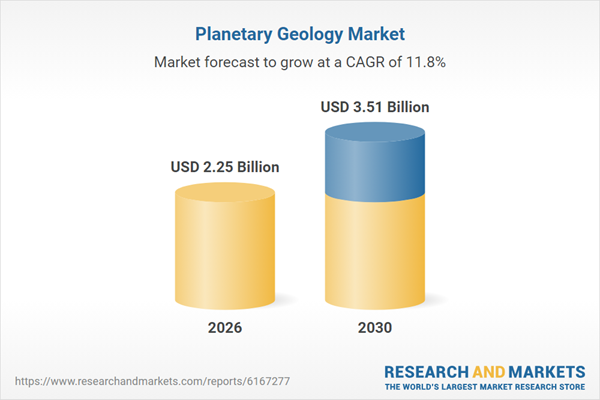
Looking forward, the market is anticipated to grow to $3.51 billion by 2030, reflecting a CAGR of 11.8%. Key drivers include the growing commercial interest in lunar and asteroid exploration, which demands sophisticated geological analysis and the adoption of high-resolution imaging coupled with autonomous mapping technologies. Additionally, there is increasing reliance on data analytics tools to process planetary research data, which bolsters focus on extraterrestrial resource identification for future mining feasibility studies. Trends in this period also emphasize advanced geological mapping for lunar and martian colonization planning and the proliferation of contract-based planetary data interpretation services.
The expansion of the planetary geology market is fueled by increased investment in space exploration, capitalizing on opportunities in satellite deployment, space tourism, and data services. Noteworthy examples include the European Space Agency's report citing a global space budget of €121 billion ($138.75 billion) in 2024, indicating a 7% increase from the previous year. Such investments underpin missions exploring the composition and history of planets, moons, and asteroids.
Technological advances in interplanetary spacecraft are a focal point for major market players aiming to enhance exploration capabilities. NASA's Europa Clipper mission, launched in October 2024, exemplifies this technological leap. Its robust suite of scientific instruments is intended for thorough examination of Jupiter's moon Europa. Similarly, the partnership between Japan-based ispace Inc. and SpaceData Inc. in March 2025 aims to marry lunar lander technology with advanced geological analysis for improved lunar exploration and resource mapping.
Dominant companies within this market include Lockheed Martin Corporation, Airbus SE, Thales SA, and others, while North America remains the largest regional market as of 2025. Asia-Pacific is poised to be the fastest-growing region during the forecast period, encompassing nations such as China, India, and Japan.
However, the market faces potential disruptions from fluctuating trade relations and tariffs, affecting production costs. These dynamics particularly impact sensor-heavy segments critical to precision geological analysis, pushing research institutions to overcome budgetary challenges. Meanwhile, the situation could stimulate local innovation and supply-chain diversification.
Research Coverage:
- The report offers an examination of the market's characteristics, highlighting products and services, brand differentiation, and innovation trends.
- Supply chain analysis encompasses the full value chain, from raw materials to suppliers, identifying competitors across different levels.
- It explores emerging tech trends such as AI, digital transformation, and sustainability initiatives, offering strategies for competitive positioning.
- The report reviews key regulatory frameworks and investment landscapes influencing growth and innovation.
- Forecasts are grounded in a range of influential factors, including tech advancements, current geopolitical events, and economic indicators.
- TAM analysis sections provide strategic insights and reveal growth opportunities through market potential assessments.
- Market segmentations explore different components, applications, and end-user perspectives, offering expansive coverage.
Key Attributes
| Report Attribute | Details |
| No. of Pages | 250 |
| Forecast Period | 2026-2030 |
| Estimated Market Value (USD) in 2026 | $2.25 Billion |
| Forecasted Market Value (USD) by 2030 | $3.51 Billion |
| Compound Annual Growth Rate | 11.8% |
| Regions Covered | Global |
The companies featured in this Planetary Geology market report include:
- Lockheed Martin Corporation
- Airbus SE
- Thales SA
- Ball Corp Aerospace & Technologies Corp
- Carl Zeiss Microscopy GmbH
- Bruker Corporation
- Maxar Technologies Inc
- Leica Geosystems AG
- Earth Science Systems Inc
- Sensors & Software AG Inc
- Sercel SAS
- ESG Solutions Ltd
- GEOSPACE Technologies Corporation
- Honeybee Robotics Ltd
- Guralp Systems Ltd
- Malin Space Science Systems Inc
- Scintrex Limited
- Officina Stellare
- RMS Instruments Inc
- Radar Systems Inc.
- Geonics Ltd.
For more information about this report visit https://www.researchandmarkets.com/r/rsrh1a
About ResearchAndMarkets.com
ResearchAndMarkets.com is the world's leading source for international market research reports and market data. We provide you with the latest data on international and regional markets, key industries, the top companies, new products and the latest trends.
Attachment
CONTACT:
CONTACT: ResearchAndMarkets.com
         Laura Wood, Senior  Press Manager
         press@researchandmarkets.com
         For E.S.T Office Hours Call 1-917-300-0470
         For U.S./ CAN Toll Free Call 1-800-526-8630
         For GMT Office Hours Call +353-1-416-8900


| About us | Network | Partners |
| Fpgroup.nlinfo@analist.nlRSS feedContactIntellectual Property Photos |
Analist.nlLinksISIN
|
MorningstarPrudena.comAAII.comNASDAQvwd GroupEuronextBATS Chi-x |
