
AI in Behavioral Healthcare Market: A US$ 115.65 Billion Size by 2034 at a 7.69% CAGR
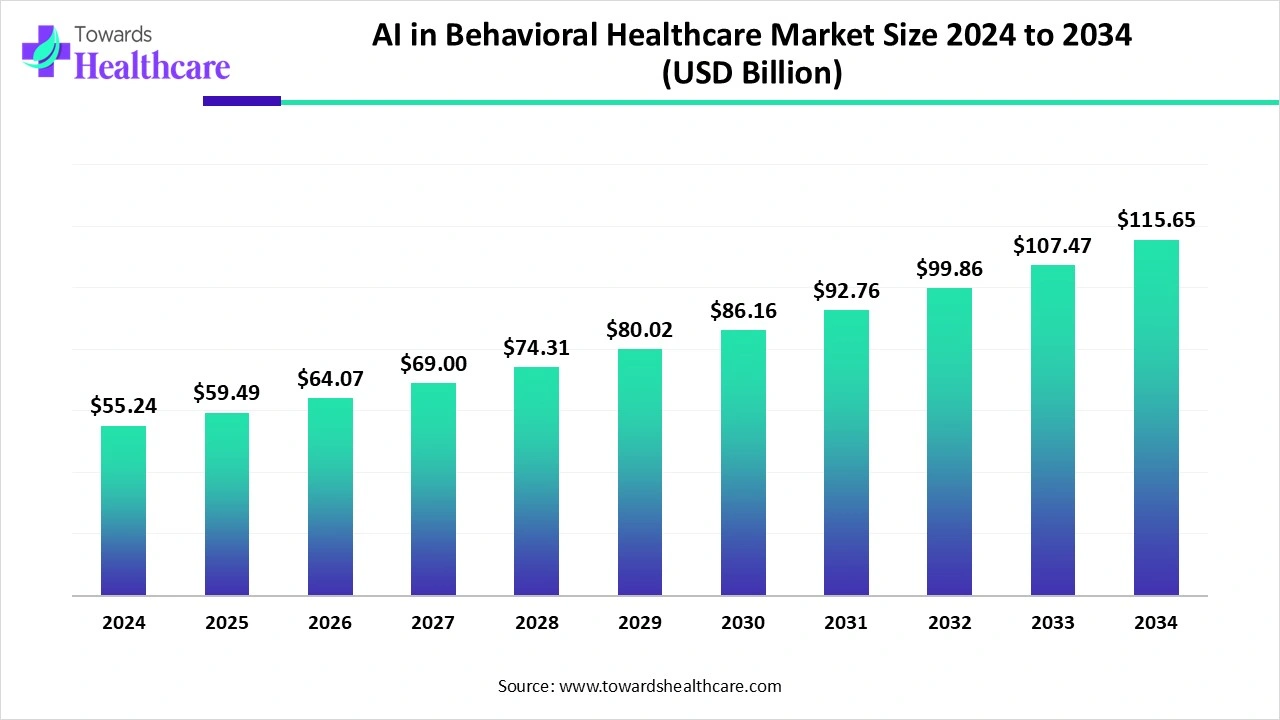
The global AI in behavioral healthcare market size was valued at USD 55.24 billion in 2024 and is predicted to hit around USD 115.65 billion by 2034, rising at a 7.69% CAGR, a study published by Towards Healthcare a sister firm of Precedence Research.
Ottawa, Jan. 07, 2026 (GLOBE NEWSWIRE) -- The global AI in behavioral healthcare market size is calculated at USD 64.07 billion in 2026 and is expected to reach around USD 115.65 billion by 2034, growing at a CAGR of 7.69% for the forecasted period.
The Complete Study is Now Available for Immediate Access | Download the Sample Pages of this Report @ https://www.towardshealthcare.com/download-sample/5579
Key Takeaways
- AI in behavioral healthcare market crossed USD 55.24 billion by 2024.
- Market projected at USD 115.65 billion by 2034.
- CAGR of 7.69% is expected between 2025 and 2034.
- North America registered dominance in the market in 2024.
- Asia-Pacific is expected to be the fastest-growing region in the upcoming years.
- By technology, the natural language processing segment led the market in 2024.
- By technology, the machine learning segment is expected to witness rapid expansion during the forecast period.
- By component, the software-as-a-service segment dominated the AI in behavioral healthcare market in 2024.
- By component, the hardware segment is expected to grow at a rapid CAGR during 2025-2034.
- By application, the conversational interface segment accounted for the largest share of the market in 2024.
- By application, the patient behavioral pattern recognition segment is expected to grow rapidly in the upcoming years.
- By end-user, the hospitals and clinics segment led the market in 2024.
- By end-user, the mental health centers segment is expected to grow fastest during the forecast period.
What are the Major Technological Advances in AI in Behavioral Healthcare?
Across the globe, AI has showcased diverse approaches to enhance mental health through tailored interventions, early detection of symptoms, and virtual therapy platforms in the AI in behavioral healthcare market. Alongside, the key firms are advancing ML, Deep Learning, and NLP, which further allows for more sophisticated tools. Moreover, AI has substantial advantages, like it provides discreet, 24/7 support. Recently, gen AI has been used for clinical documentation, such as Abridge and Nuance's DAX Copilot, which are prominent solutions that majorly lower the administrative burden and enable clinicians to emphasize greater patient care.
What are the Major Drivers in the AI in Behavioral Healthcare Market?
Ongoing innovations in Natural Language Processing (NLP) and Machine Learning (ML) are fostering more accurate diagnosis, customized treatment strategies, and real-time patient monitoring through the analysis of vast datasets. Moreover, the market is propelled by a rise in public awareness and minimal social stigma surrounding mental health conditions, which supports more individuals who are looking for help through discreet AI-driven platforms. Whereas, governments & private sector investors are highly funding AI in healthcare R&D, with the execution of favourable policies.
You can place an order or ask any questions, please feel free to contact us at sales@towardshealthcare.com
What are the Key Trends in the AI in Behavioral Healthcare Market?
- In December 2025, Ritten announced a $35 million USD Series B funding round powered by Five Elms Capital for bolstering Ritten across mental health and addiction treatment providers, boosting all levels of care.
- In October 2025, Onos Health, a healthcare AI company, raised $6.3 million in an oversubscribed venture round to promote its platform and meet rising demand from significant U.S. health insurers.
- In July 2025, Unmind, a British workplace mental health startup, raised €30.6 million in a Series C funding round to further explore its AI-enabled platform developed to support employee mental health.
What is the Vital Challenge in the AI in Behavioral Healthcare Market?
Numerous AI solutions still limit robust, large-scale clinical trials and validation to prove their safety and efficiency in real-world settings, which creates a hurdle to the overall market progression. Alongside, the globe is still developing regulatory guidelines for AI-driven medical devices, which results in uncertainty about oversight, accountability, and legal liability in cases of error.
Regional Analysis
How did North America Dominate the Market in 2024?
With the largest share, North America led the AI in behavioral healthcare market in 2024. This region has a strong hub for innovating AI in mental health companies, with advantages from prominent investments from leading tech firms and venture capital. Whereas the U.S. is widely leveraging AI tools by using ambient listening technology to transcribe patient-provider conversations in real-time and automatically draft clinical notes and summaries, lowering documentation time by up to 50%, as NextGen Ambient Assist launched in 2024.
For instance,
- In January 2025, Eleos, the company in AI for behavioral health, announced a $60M Series C funding round led by Greenfield Partners, to revolutionize behavioral health with AI agents.
In the U.S., AI adoption in behavioral healthcare is expanding rapidly as digital tools and digital therapy platforms gain traction across clinics, telehealth services, and wellness apps. Major healthcare agencies and tech companies are investing in AI-driven solutions for early detection, personalized support, and broader access, reflecting increased integration of machine learning and natural language processing into mental health services. Funding opportunities and strategic government plans are also pushing responsible AI innovation to improve data quality and expand behavioral health projects.
Why did the Asia Pacific Expand Significantly in the Market in 2024?
Asia Pacific will grow at the fastest CAGR in the AI in behavioral healthcare market. Due to the rising active promotion of mental health initiatives by China, India, and Japan, with substantial investments in AI-powered healthcare technologies, APAC is bolstering. Recently, the Indian government worked with AI startups to roll out smart teleconsultation systems in rural areas, and AIIMS Delhi unveiled an AI-powered app for student mental health. Recently, Japan, South Korea, and China signed a cooperation agreement to employ AI and digital technologies for displaying mental well-being risks and universal health coverage.
In China, AI in behavioral health is also growing strongly, fueled by widespread digital platform use and government support for tech-enabled healthcare. Consumers increasingly turn to AI chatbots and virtual tools for mental health support, particularly where access to traditional services is limited or stigmatized. Domestic AI systems are being built into mainstream apps and health initiatives, helping scale behavioral care and early intervention, while cultural shifts and large online populations accelerate adoption.
Various Startups’ Efforts in the AI in Behavioral Healthcare Market
| Slingshot AI | In 2025, it introduced Ash, a generative AI therapy chatbot, which specialises in psychology and evidence-based methods, such as CBT and DBT. |
| UpLift Ai | In 2025, it established "Astra," an AI co-therapist for maintaining therapeutic momentum between sessions to lower patient dropout. |
| TranquilMind | In 2024, a startup unveiled VYNA, a companion using voice, text, and video to track emotional cues from behavior and environmental signals. |
| Upheal | In 2024, it raised $10M Series A, to automate the growth of notes for mental health professionals. |
valued research partner with us - https://www.towardshealthcare.com/schedule-meeting
Segmental Insights
By technology analysis
Which Technology Led the AI in Behavioral Healthcare Market in 2024?
The natural language processing segment captured the dominating share of the market in 2024. It has broader advantages in enhancing patient engagement, automating clinical documentation, utilising large language models (LLMs) for insights, managing complex data, and meeting regulatory demands for better access, including the Cures Act. Recently developed Alphabet 's Med-PaLM and models from Microsoft and Amazon are being especially fine-tuned on medical and clinical datasets to boost accuracy and lower "hallucinations".
Moreover, the machine learning segment is predicted to expand rapidly. ML solutions are supporting therapeutic plans, like specific content in CBT apps, medication suggestions, and individual patient essentials and estimated responses, further optimizing treatment adherence and results. Inclusion of prominent solutions, such as RADAR-MDD, which uses multimodal data integration for tracking mood changes and relapse risk in real-time for patients with depression.
By component analysis
How did the Software-as-a-Service Segment Dominate the Market in 2024?
In 2024, the software-as-a-service segment registered dominance in the AI in behavioral healthcare market. SaaS mainly provides minimal expenditures, increased accessibility, excellent security, and enhanced effectiveness through simplified workflows, etc. Alongside, they offer a robust alliance between mental and physical health, with the use of data to connect patients with appropriate services, for example, NeuroFlow's acquisition of Quartet. Additionally, it simplifies practice management, billing, custom forms, and treatment plan management, like Valant's platform updates.
However, the hardware segment is predicted to register rapid expansion in the coming era. This primarily covers wearable devices for consistent monitoring, virtual reality (VR) and augmented reality (AR) systems for rigorous therapy, and specialized neurostimulation devices. The latest advances include smart medication dispensers, which support treatment adherence by facilitating reminders and monitoring dosage intake, specifically in schizophrenia and bipolar disorder. Hardware, like EEG headsets, neurofeedback systems, and AI-assisted hardware accelerators are employed in complex data processing, diagnostics, and neurostimulation therapies, mainly for treatment-resistant disorders.
By application analysis
Which Application Dominated the AI in Behavioral Healthcare Market in 2024?
The conversational interface segment captured the biggest share of the market in 2024. It is driven by a raised emphasis on emotional intelligence, agentic AI capable of autonomous action, hyper-personalization, & hybrid human-AI care models. AI is enabling users to share screenshots for troubleshooting or use facial expressions in VR settings, which strengthens the depth of interaction. Kintsugi is a recently evolved AI-powered teletherapy platform that employs voice analysis to offer real-time emotional feedback to human therapists during sessions.
Whereas the patient behavioral pattern recognition segment is anticipated to witness the fastest growth. A prominent catalyst is the widespread adoption of wearable devices, telehealth platforms, and electronic health records (EHRs), which provide an abundant, continuous stream of data for AI systems for tracking and analyzing patient behavior in real-time. Nowadays, numerous firms are focusing on progression in remote patient monitoring, mental health platforms, and predictive analytics. Also, Northwestern University used smartphone sensors to record and study behavior, estimating depressive episodes with 90% accuracy.
By end-user analysis
How did the Hospitals and Clinics Segment Lead the Market in 2024?
In 2024, the hospitals and clinics segment held a major revenue share of the AI in behavioral healthcare market. Requirements for addressing the crucial limitation of mental health professionals, minimizing administrative burdens, and offering more tailored, accessible, and affordable care are fostering the use of AI. Specifically, Stanford, Mass General Brigham, and the University of Michigan Health are increasingly utilising digital scribes to record doctor-patient conversations and develop clinical notes automatically.
Furthermore, the mental health centers segment will expand rapidly in the future. They are widely using AI-powered assessment tools for the analysis of patient data to flag at-risk individuals, which ultimately enhances the early detection of disorders, including anxiety, depression, and schizophrenia. AI solutions assist these centers in the creation of highly personalized treatment strategies based on a patient's unique psychological profile, medical history, and treatment responses. Also, they broadly leverage AI-enabled chatbots and virtual therapists to reach underserved populations.
Get the latest insights on life science industry segmentation with our Annual Membership: https://www.towardshealthcare.com/get-an-annual-membership
What are the Transforming Developments in the AI in Behavioral Healthcare Market?
- In December 2025, Rula, a national behavioral healthcare provider, launched Rula Recap, an AI-based note-taking tool to assist providers in developing high-quality clinical documentation more effectively.
- In November 2025, Michigan-based digital healthcare provider Mentavi Health launched Mentavi Concierge, a next-gen AI-driven assistance system, to ensure responsible and efficient mental health support.
- In October 2025, Delhi-based startup Solh Wellness introduced Streffie, India’s foremost AI-assisted stress monitoring kiosk, at the Indian Mobile Congress (IMC) 2025, held at Yashobhoomi, Dwarka.
Browse More Insights of Towards Healthcare:
The global behavioral health EHR market is on an upward trajectory, poised to generate substantial revenue growth, potentially climbing into the hundreds of millions over the forecast years from 2025 to 2034.
The global behavioral health software market size is calculated at US$ 3.44 billion in 2024, grew to US$ 4.13 billion in 2025, and is projected to reach around US$ 20.79 billion by 2034. The market is expanding at a CAGR of 19.85% between 2025 and 2034.
The global behavioral rehabilitation market is expected to increase from USD 171.88 billion in 2025 to USD 244.33 billion by 2035, growing at a CAGR of 3.58% throughout the forecast period from 2026 to 2035.
The dialectical behavior therapy market size was reported at US$ 1.31 billion in 2025 and is expected to rise to US$ 1.44 billion in 2026. According to forecasts, it will grow at a CAGR of 9.67% to reach US$ 3.29 billion by 2035.
The APAC behavioral health market size is calculated at USD 19.07 billion in 2024, grew to USD 21.46 billion in 2025, and is projected to reach around USD 56.58 billion by 2034. The market is expanding at a CAGR of 11.49% between 2025 and 2034.
The U.S. behavioral health market size was calculated at USD 96.9 billion in 2025, to reach USD 101.84 billion in 2026 is expected to be worth USD 159.35 billion by 2035, expanding at a CAGR of 5.1% from 2024 to 2034.
The North America behavioral health market size is calculated at US$ 109.21 billion in 2024, grew to US$ 115.65 billion in 2025, and is projected to reach around US$ 193.03 billion by 2034. The market is expanding at a CAGR of 5.86% between 2025 and 2034.
The Latin America behavioral health market size reached US$ 5.2 billion in 2024 and is anticipate to increase to US$ 5.55 billion in 2025. By 2034, the market is forecasted to achieve a value of around US$ 9.98 billion, growing at a CAGR of 6.74%.
The global cognitive behavioral therapy market size is calculated at US$ 7.77 in 2024, grew to US$ 9.01 billion in 2025, and is projected to reach around US$ 34.25 billion by 2034. The market is expanding at a CAGR of 15.99% between 2025 and 2034.
The global digital behavioral health market size is calculated at USD 27.9 billion in 2024, grew to USD 33.1 billion in 2025, and is projected to reach around USD 153.85 billion by 2034. The market is expanding at a CAGR of 18.6% between 2025 and 2034.
AI in Behavioral Healthcare Market Key Players List
- Woebot Labs
- Mindstrong Health
- Lyra Health
- Wysa
- Mantra Health
- Cohere Health
- Healthee
- Enlitic
- Hippocratic AI
- Headspace Health
Segments Covered in the Report
By technology
- Natural Language Processing (NLP)
- Machine Learning (ML)
By component
- Software-as-a-Service (SaaS)
- Hardware
By application
- Conversational Interfaces
- Patient Behavioral Pattern Recognition
By end-User
- Hospitals and Clinics
- Mental Health Centers
- Research Institutions
By Regions
- North America
- U.S.
- Canada
- Europe
- UK
- Germany
- France
- Italy
- Spain
- Denmark
- Sweden
- Norway
- Asia Pacific
- Japan
- China
- India
- South Korea
- Australia
- Thailand
- Latin America
- Brazil
- Mexico
- Argentina
- Middle East & Africa
- South Africa
- Saudi Arabia
- UAE
- Kuwait
Immediate Delivery Available | Buy This Premium Research @ https://www.towardshealthcare.com/checkout/5579
Access our exclusive, data-rich dashboard dedicated to the healthcare market - built specifically for decision-makers, strategists, and industry leaders. The dashboard features comprehensive statistical data, segment-wise market breakdowns, regional performance shares, detailed company profiles, annual updates, and much more. From market sizing to competitive intelligence, this powerful tool is one-stop solution to your gateway.
Access the Dashboard: https://www.towardshealthcare.com/access-dashboard
About Us
Towards Healthcare is a leading global provider of technological solutions, clinical research services, and advanced analytics, with a strong emphasis on life science research. Dedicated to advancing innovation in the life sciences sector, we build strategic partnerships that generate actionable insights and transformative breakthroughs. As a global strategy consulting firm, we empower life science leaders to gain a competitive edge, drive research excellence, and accelerate sustainable growth.
You can place an order or ask any questions, please feel free to contact us at sales@towardshealthcare.com
Europe Region: +44 778 256 0738
North America Region: +1 8044 4193 44
APAC Region: +91 9356 9282 04
Web: https://www.towardshealthcare.com
Our Trusted Data Partners
Precedence Research | Towards Packaging | Towards Food and Beverages | Towards Chemical and Materials | Towards Dental | Towards EV Solutions | Healthcare Webwire
Find us on social platforms: LinkedIn | Twitter | Instagram | Medium | Pinterest


| About us | Network | Partners |
| Fpgroup.nlinfo@analist.nlRSS feedContactIntellectual Property Photos |
Analist.nlLinksISIN
|
MorningstarPrudena.comAAII.comNASDAQvwd GroupEuronextBATS Chi-x |
