
Demand for Early and Accurate Diagnosis Pushes Ultra-High-End CT Scanners Market Toward USD 10.69 Billion by 2034
The global ultra-high-end CT scanners market size was valued at USD 5.89 billion in 2024 and is predicted to hit around USD 10.69 billion by 2034, rising at a 6.16% CAGR, a study published by Towards Healthcare a sister firm of Precedence Research.
Ottawa, Dec. 03, 2025 (GLOBE NEWSWIRE) -- The global ultra-high-end CT scanners market size is calculated at USD 6.25 billion in 2025 and is expected to reach around USD 10.69 billion by 2034, growing at a CAGR of 6.16% for the forecasted period.
The growth of the market is driven by the rising prevalence of chronic diseases, the increasing demand for early and accurate diagnosis, and advancements in technology.

The Complete Study is Now Available for Immediate Access | Download the Sample Pages of this Report @ https://www.towardshealthcare.com/download-sample/6388
Key Takeaways
- North America held approximately a 39% share in the global ultra-high-end CT scanners market in 2024.
- Asia Pacific is expected to be the fastest-growing region during the forecast period.
- By technology type, the 256–320 slice CT scanners segment held an approximate 38% share in the market in 2024.
- By technology type, the photon-counting CT (spectral CT) segment is expected to be the fastest growing during the forecast period.
- By application type, the Cardiovascular imaging segment held approximately a 32% share in the market in 2024.
- By application type, the oncology imaging segment is expected to be the fastest-growing during the forecast period.
- By detector type, the conventional energy-integrating detectors (EID) segment held approximately a 60% share in the market in 2024.
- By detector type, the photon-counting detectors (PCD) segment is expected to be the fastest growing during the forecast period.
- By end user, the hospitals (tertiary & speciality centres) segment held an approximate 55% share in the global ultra-high-end CT scanners market in 2024.
- By end user, the diagnostic imaging centres segment is expected to be the fastest growing during the forecast period.
Market Overview & Potential
The ultra-high-end CT scanners market is driven by growing technological innovations like dual energy capabilities, artificial intelligence (AI) integration, and photo counting detectors. The ultra-high-end CT scanners encompass the development, production, and commercialisation of premium computed tomography (CT) systems offering ultra-fast imaging speeds, high spatial resolution, and advanced spectral or photon-counting capabilities. These systems (typically ≥256-slice and dual-source or spectral detectors) enable ultra-precise cardiac imaging, whole-organ perfusion, oncology staging, neurovascular assessment, and trauma diagnosis.
You can place an order or ask any questions, please feel free to contact us at sales@towardshealthcare.com
What is the Growth Potential Responsible for The Growth of The Ultra-High-End CT Scanners Market?
The main market drivers for ultra-high-end CT scanners are the rising prevalence of chronic diseases like cancer and cardiovascular conditions, the increasing demand for early and accurate diagnosis, and advancements in technology like AI-powered imaging, photon-counting detectors, and dual-energy CT. These factors fuel the need for high-resolution, fast, and specialised imaging to improve patient outcomes. Additionally, growing healthcare infrastructure in emerging markets and higher healthcare spending in developed regions also contribute to market growth.
What Are the Growing Trends Associated with the Ultra-High-End CT Scanners Market?
Specialisation: The market is moving toward a diverse array of specialised systems, some optimised for dose efficiency, others for speed, and some for broad volume coverage, rather than a one-size-fits-all approach.
AI integration: Artificial intelligence is being integrated into CT scanners for tasks such as automatic dose adjustment, protocol selection, and image reconstruction to improve efficiency and reduce radiation exposure.
Ultra-high resolution: The development of nano-CT scanners is driven by the demand for sub-micron precision in research, oncology, and neurology, with 50 nm resolution systems gaining traction in niche applications.
Shift in clinical applications: While oncology remains the largest application, the neurology sector is the fastest-growing, followed by significant growth in the musculoskeletal area.
What Is the Growing Challenge in the Ultra-High-End CT Scanners Market?
The ultra-high-end CT scanner market faces challenges from high acquisition and maintenance costs, a shortage of skilled personnel, rapid technological advancements, and regulatory hurdles. These high costs limit adoption for smaller healthcare facilities, while the pace of innovation requires continuous, expensive upgrades. Regulatory approvals, reimbursement policies, and the need for trained staff to operate complex systems are also significant barriers.
Become a valued research partner with us - https://www.towardshealthcare.com/schedule-meeting
Regional Analysis
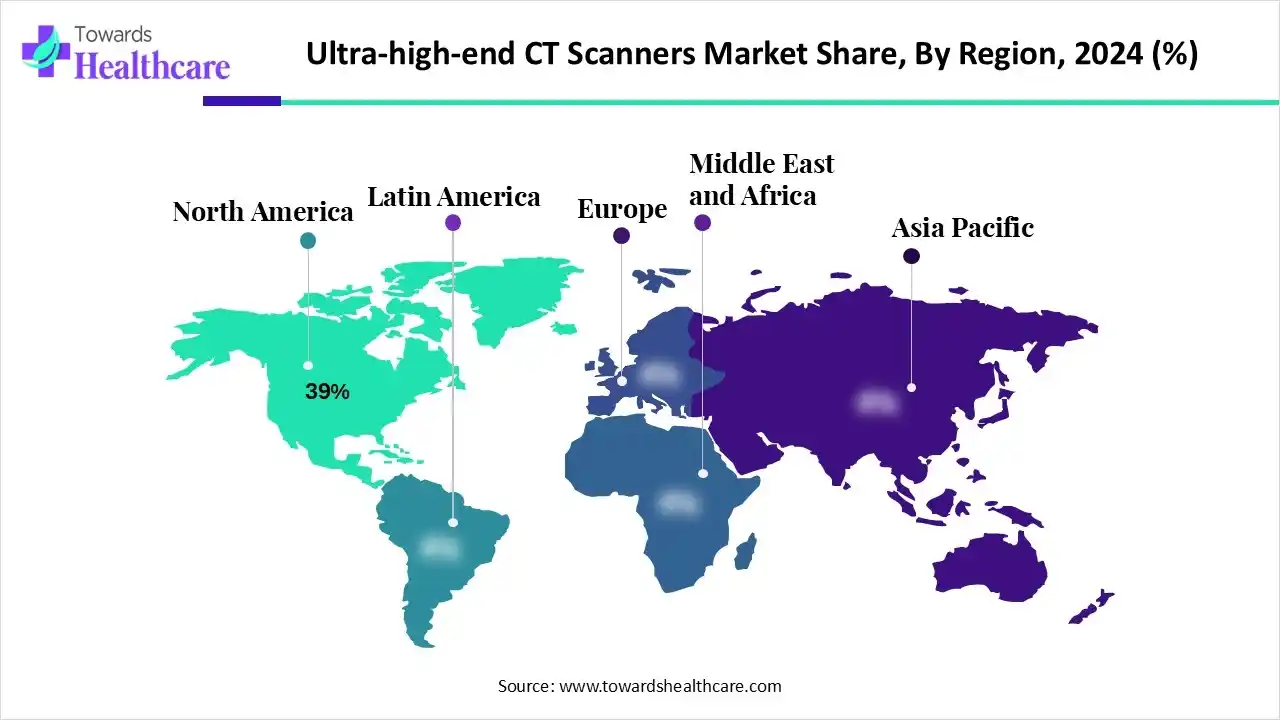
How Did North America Dominate the Ultra-High-End CT Scanners Market in 2024?
North America held approximately a 39% share in the global ultra-high-end CT scanners market in 2024. The North American market for ultra-high-end CT scanners is robust, driven by a high prevalence of chronic diseases, a strong healthcare infrastructure, and significant investment in advanced technology, especially in the United States. The growth drivers include the need for better imaging for cancer and cardiovascular diseases, strategic partnerships between manufacturers, and favorable reimbursement policies, which drive the growth of the market in the region.
What Made the Asia Pacific Significantly Grow in The Ultra-High-End CT Scanners Market In 2024?
Asia Pacific is expected to be the fastest-growing region during the forecast period. The ultra-high-end CT scanner market in the Asia Pacific region is growing, driven by demand from large hospital chains for advanced diagnostic tools like photon-counting and high-slice systems. Japan leads in market penetration due to its advanced infrastructure, while countries like China and India are seeing strong growth due to government incentives and rising chronic disease cases. The growth of the market is driven by the need for advanced cancer detection, cardiovascular imaging, and image-guided radiation therapy.
Segmental Insights
By technology type,
The 256–320 slice CT scanners segment held an approximate 38% share in the market in 2024. 256–320 slice CT scanners are widely used in advanced diagnostic settings because they offer exceptional image speed, whole-organ coverage, and reduced motion artefacts. These systems are particularly effective for cardiac and trauma imaging, allowing clinicians to capture detailed 3D datasets in a single rotation. Their ability to perform rapid, high-resolution scans continues to drive adoption across tertiary hospitals.
The photon-counting CT (spectral CT) segment is expected to be the fastest-growing during the forecast period. Photon-counting CT scanners represent the next generation of high-precision imaging, providing superior spatial resolution, improved tissue differentiation, and lower radiation doses compared to conventional systems. Their advanced detector design enables multi-energy imaging in a single scan, making them highly suitable for oncology, cardiovascular diagnostics, and complex clinical research applications. Growing investments in premium radiology infrastructure accelerate demand.
By application type,
The cardiovascular imaging segment held approximately a 32% share in the market in 2024. Ultra-high-end CT scanners play a critical role in cardiovascular imaging by offering fast acquisition times, detailed coronary artery visualisation, and accurate plaque characterisation. Photon counting and high-slice CT systems help clinicians detect early stages of heart disease with high diagnostic confidence. Their ability to assess cardiac function and anatomy non-invasively supports strong adoption in cardiac speciality centres.
The oncology imaging segment is expected to be the fastest-growing during the forecast period. In oncology, these scanners enable highly detailed tumour visualisation, staging, and treatment planning. Their superior spatial resolution helps detect small lesions with greater clarity, improving early diagnosis and longitudinal monitoring. Multi-energy capabilities provide enhanced tissue characterisation, while faster scanning speeds reduce motion artefacts. As cancer care advances, premium CT technology becomes essential for precision imaging.
Get the latest insights on life science industry segmentation with our Annual Membership: https://www.towardshealthcare.com/get-an-annual-membership
By detector type,
The conventional energy-integrating detectors (EID) segment held approximately a 60% share in the market in 2024. Conventional energy-integrating detectors are widely used due to their proven reliability and cost-effectiveness. They capture high-resolution images by integrating all incoming X-ray energy into a single signal. Although they provide strong image quality, they lack the spectral precision of photon-counting detectors. These systems remain standard in many high-end CT scanners, especially where budget considerations matter.
The photon-counting detectors (PCD) segment is expected to be the fastest-growing during the forecast period. Photon counting detectors are transforming CT imaging by capturing individual photons and assigning precise energy values to each. This results in sharper images, enhanced contrast, and significantly improved lesion detectability with reduced noise. The technology also supports lower radiation doses and better material differentiation, making it ideal for advanced diagnostic centres and research settings.
By end user,
The hospitals (tertiary & speciality centres) segment held an approximate 55% share in the global ultra-high-end CT scanners market in 2024. Tertiary and speciality hospitals are the primary adopters of ultra-high-end CT scanners because they require advanced imaging capabilities for complex cardiac, oncology, trauma, and neurological cases. These centres prioritise precision diagnostics, multi-modality integration, and high patient throughput. Investments in cutting-edge photon counting systems and high-slice scanners support their role as regional referral and advanced care hubs.
The diagnostic imaging centres segment is expected to be the fastest-growing during the forecast period. Independent diagnostic imaging centres are increasingly investing in ultra-high-end CT scanners to expand service offerings and attract complex referrals. These scanners allow them to deliver premium cardiac and oncology imaging with high accuracy and shorter scan times. Competitive healthcare markets and patient demand for faster, clearer results drive adoption among large imaging networks and urban diagnostic chains.
Browse More Insights of Towards Healthcare:
The global teleradiology market size is calculated at US$ 10.16 billion in 2025, grew to US$ 11.61 billion in 2026, and is projected to reach around US$ 38.43 billion by 2035. The market is expanding at a CAGR of 14.23% between 2026 and 2035.
The AI in medical imaging market size is forecasted to expand from USD 1.79 billion in 2025 to USD 26.23 billion by 2034, growing at a CAGR of 34.8% from 2025 to 2034.
The newborn imaging system market size is projected to reach USD 484.9 million by 2034, expanding from USD 323.5 million in 2025, at an annual growth rate of 4.6% during the forecast period from 2025 to 2034.
The optical imaging market was estimated at US$ 2.03 billion in 2023 and is projected to grow to US$ 6.55 billion by 2034, rising at a compound annual growth rate (CAGR) of 11.24% from 2024 to 2034.
The global digital breast tomosynthesis market size is calculated at USD 3.03 billion in 2024, grew to USD 3.45 billion in 2025, and is projected to reach around USD 10.89 billion by 2034. The market is expanding at a CAGR of 13.63% between 2025 and 2034.
The automated medical coding market is rapidly advancing on a global scale, with expectations of accumulating hundreds of millions in revenue between 2025 and 2034.
The global portable ultrasound market size touched US$ 2.35 billion in 2024, with expectations of climbing to US$ 2.56 billion in 2025 and hitting US$ 5.53 billion by 2034, driven by a CAGR of 8.94% over the forecast period.
The global ophthalmic imaging market size is calculated at USD 2.66 billion in 2024, grew to USD 2.83 billion in 2025, and is projected to reach around USD 4.83 billion by 2034. The market is expanding at a CAGR of 6.27% between 2025 and 2034.
The global optical coherence tomography market size was estimated at US$ 2.26 billion in 2024, projected to increase to US$ 2.62 billion in 2025 and reach US$ 10 billion by 2034, showing a healthy CAGR of 15.97% across the forecast years.
Recent Developments
- In August 2025, to launch a new portfolio of mobile CT products, a collaboration between Samsung India and NeuroLogica was announced. These products will provide an AI-powered system to enhance the accessibility of advanced imaging.
- In March 2025, to launch photon-counting CT technology, a press conference titled “Unlocking the Future of Screening & Diagnostics with Photon-Counting CT Technology” was held by Bumrungrad International Hospital. This technology provides high-resolution images, accuracy, and speed, which help in the early detection of diseases.
Who are Ultra-High-End CT Scanners Market Key Players?
- Fujifilm Holdings Corporation
- Neusoft Medical Systems Co., Ltd.
- Samsung Medison Co., Ltd.
- Hitachi Healthcare (Fujifilm Group)
- Mindray Medical International Ltd.
- Carestream Health Inc.
- Medtronic plc
- Agfa-Gevaert N.V.
- Esaote S.p.A.
- Shimadzu Corporation
- Konica Minolta Healthcare Americas, Inc.
- Planmed Oy
- CurveBeam AI Ltd.
- Micro-X Ltd.
- Analogic Corporation
Segments Covered in The Report
By Technology Type
- 256–320 Slice CT Scanners
- 512–640 Slice CT Scanners
- Dual-Source CT Scanners
- Photon-Counting CT (Spectral CT)
- Others (Dynamic Volume, Energy-Discriminating CT)
By Application
- Cardiovascular Imaging
- Oncology Imaging
- Neurology & Stroke Assessment
- Musculoskeletal & Orthopedic Imaging
- Pulmonary & Infectious Disease Imaging
- Others (Trauma, Paediatrics, Research)
By Detector Type
- Conventional Energy-Integrating Detectors (EID)
- Photon-Counting Detectors (PCD)
- Dual-Layer Spectral Detectors
By End User
- Hospitals (Tertiary & Specialty Centers)
- Diagnostic Imaging Centres
- Academic & Research Institutes
- Cardiology & Oncology Clinics
- Others (Veterinary, Mobile Units)
By Region
- North America
- U.S.
- Canada
- Asia Pacific
- China
- Japan
- India
- South Korea
- Thailand
- Europe
- Germany
- UK
- France
- Italy
- Spain
- Sweden
- Denmark
- Norway
- Latin America
- Brazil
- Mexico
- Argentina
- Middle East and Africa (MEA)
- South Africa
- UAE
- Saudi Arabia
- Kuwait
Immediate Delivery Available | Buy This Premium Research @ https://www.towardshealthcare.com/checkout/6388
Access our exclusive, data-rich dashboard dedicated to the healthcare market - built specifically for decision-makers, strategists, and industry leaders. The dashboard features comprehensive statistical data, segment-wise market breakdowns, regional performance shares, detailed company profiles, annual updates, and much more. From market sizing to competitive intelligence, this powerful tool is one-stop solution to your gateway.
Access the Dashboard: https://www.towardshealthcare.com/access-dashboard
About Us
Towards Healthcare is a leading global provider of technological solutions, clinical research services, and advanced analytics, with a strong emphasis on life science research. Dedicated to advancing innovation in the life sciences sector, we build strategic partnerships that generate actionable insights and transformative breakthroughs. As a global strategy consulting firm, we empower life science leaders to gain a competitive edge, drive research excellence, and accelerate sustainable growth.
You can place an order or ask any questions, please feel free to contact us at sales@towardshealthcare.com
Europe Region: +44 778 256 0738
North America Region: +1 8044 4193 44
APAC Region: +91 9356 9282 04
Web: https://www.towardshealthcare.com
Our Trusted Data Partners
Precedence Research | Statifacts | Towards Packaging | Towards Automotive | Towards Food and Beverages | Towards Chemical and Materials | Towards Consumer Goods | Towards Dental | Towards EV Solutions | Nova One Advisor | Healthcare Webwire | Packaging Webwire | Automotive Webwire | Nutraceuticals Func Foods | Onco Quant | Sustainability Quant | Specialty Chemicals Analytics
Find us on social platforms: LinkedIn | Twitter | Instagram | Medium | Pinterest


| About us | Network | Partners |
| Fpgroup.nlinfo@analist.nlRSS feedContactIntellectual Property Photos |
Analist.nlLinksISIN
|
MorningstarPrudena.comAAII.comNASDAQvwd GroupEuronextBATS Chi-x
|
